
The 98th Academy Awards — The Complete Analysis of What Happened, Why It Happened, and What It Means for Cinema
The Night Belonged to Two Films — and They Couldn't Be More DifferentThe 98th Academy Awards ceremony, hosted by Conan O'Brien returning for his second year, pr...


The Night Belonged to Two Films — and They Couldn't Be More Different
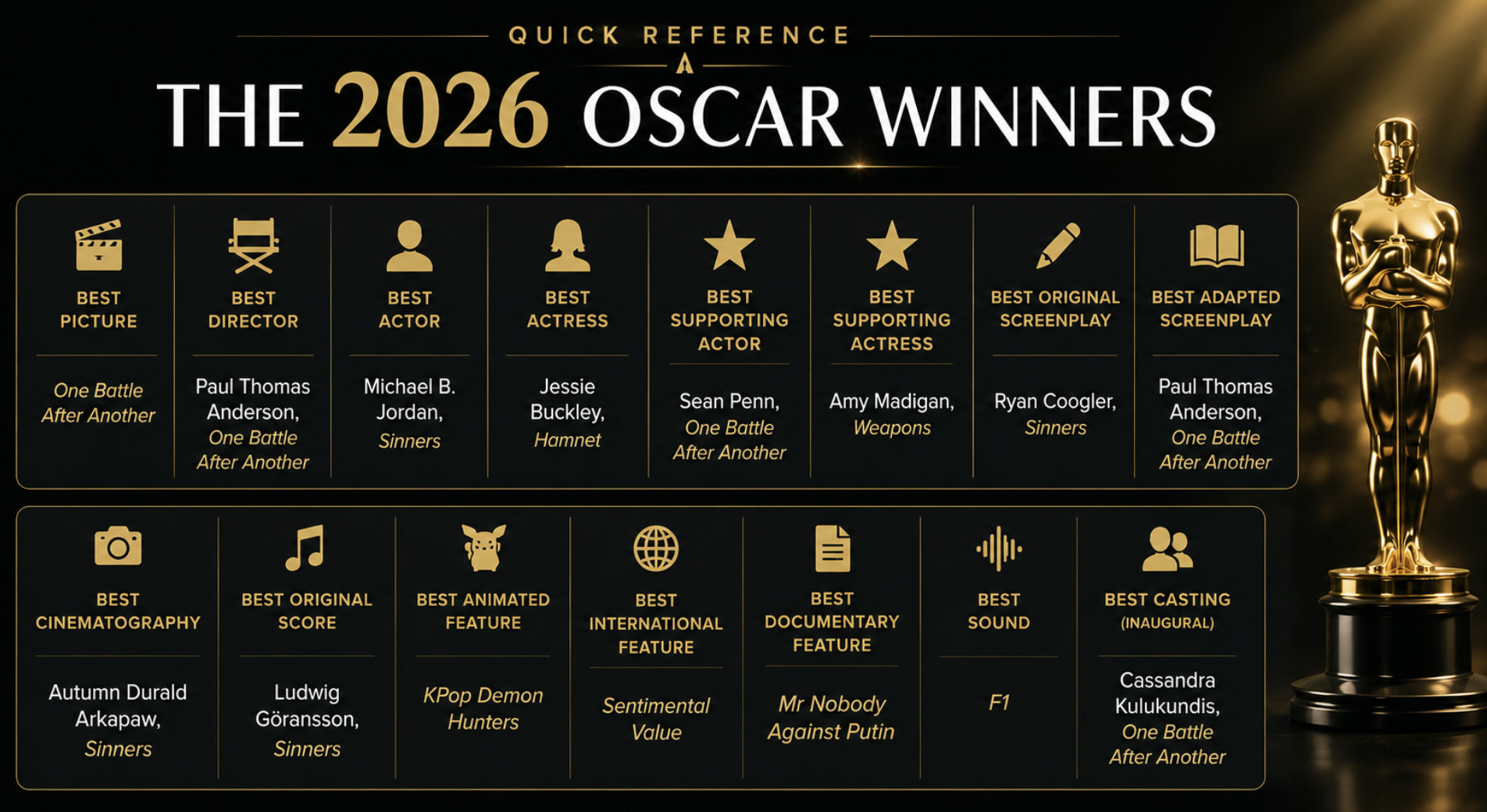
The 98th Academy Awards ceremony, hosted by Conan O'Brien returning for his second year, produced a result that will be studied by Oscar historians for a simple reason: two films split the significant awards almost perfectly, and those two films represent almost diametrically opposite artistic propositions.
One Battle After Another, Paul Thomas Anderson's black comedy about a has-been revolutionary, won six Oscars: Best Picture, Best Director, Best Adapted Screenplay, Best Supporting Actor, Best Film Editing, and the inaugural Best Casting award. Sinners, Ryan Coogler's blues-inflected supernatural horror, entered the ceremony with a record-tying 16 nominations and won four: Best Actor, Best Original Screenplay, Best Cinematography, and Best Original Score.
One Battle After Another is an adult-oriented black comedy from one of the most formally controlled directors in American cinema. Sinners is a genre film about vampires arriving at a juke joint in 1932 Mississippi that is simultaneously a meditation on Black cultural memory, the nature of evil, and the relationship between music and transcendence. The Academy awarding both so substantially is not a compromise — it is a genuine recognition that both films are extraordinary works, which they are.
Paul Thomas Anderson's First Oscar — After 11 Nominations
The most extraordinary individual story of the 2026 ceremony is Paul Thomas Anderson winning Best Picture, Best Director, and Best Adapted Screenplay on the same night — his first Academy Award after eleven previous nominations dating back to 1998. He became just the ninth person in history to win all three categories in the same ceremony, joining a list that includes Billy Wilder, Joseph L. Mankiewicz, and Joel Coen.
Anderson's relationship with the Academy has been one of the central paradoxes of contemporary American cinema. Boogie Nights, Magnolia, Punch-Drunk Love, There Will Be Blood, The Master, Inherent Vice, Phantom Thread, Licorice Pizza — nine previous films, each of which generated Academy recognition in at least one category, none of which won the top prize. The sustained quality of his filmography is not in dispute. The Academy's reluctance to give him the top award was.
One Battle After Another is, by Anderson's own account, the most commercial thing he has made since Boogie Nights — not in the blockbuster sense but in the sense of being constructed with deliberate attention to what audiences find pleasurable rather than challenging. Its black comedy structure, its ensemble performance dynamics, and its Leonardo DiCaprio-led cast gave it a broad accessibility that some of his more austere works deliberately resisted. Whether it is his best film is debatable — serious Anderson scholars will argue for There Will Be Blood or The Master. That it was his best opportunity for Academy recognition is not.
Michael B. Jordan Makes History
Michael B. Jordan's Best Actor win for Sinners is one of the rare instances in which the consensus performance of a given season and the critics' preference and the Academy's choice were all perfectly aligned. Every major precursor — the Screen Actors Guild, the Critics' Choice Awards, the BAFTA — pointed to Jordan. The Oscar was the confirmation rather than the surprise.
What makes the win historically significant is the specific quality of the performance that won it. Jordan plays twin brothers Smoke and Stack, each with distinct psychology and emotional register, and does so with a completeness that has drawn comparisons to the most demanding dual roles in cinema history. He is not playing two versions of the same character in different costumes. He is playing two fully formed people who share biology and history and virtually nothing else.
The moment when Jordan accepted the award and the room rose to its feet was described by multiple journalists present as one of the most emotionally complete acceptance-moment reactions in recent Oscar memory. The combination of the performance's quality, the cultural significance of the film, and Jordan's evident emotion produced something that the ceremony needed after several years of relatively muted evening energy.
The Firsts: Autumn Durald Arkapaw and the Inaugural Best Casting Award
Two firsts distinguished the 2026 ceremony beyond the individual performance categories.
Autumn Durald Arkapaw became the first woman to win Best Cinematography in Academy Awards history for her work on Sinners. The nomination itself was not her first — she had received previous recognition from the American Society of Cinematographers and had been on the shortlist for several years. But the win, given the category's historical male dominance, represents a genuine milestone. Her visual work on Sinners — the specific quality of light she achieved in the juke joint sequences, the way the film uses darkness as both threat and promise — is genuinely among the most accomplished cinematography of the decade.
The inaugural Best Casting Oscar, won by One Battle After Another's casting director Cassandra Kulukundis, represents the Academy's first addition of a competitive category since Best Animated Feature in 2001. The category's introduction acknowledges something that critics and industry professionals have long recognised: that casting is a creative act that shapes a film's meaning as decisively as any other element, and that the people responsible for it had been systematically overlooked by the awards ecosystem.
Sean Penn's Absence and Amy Madigan's Arrival
Sean Penn's Best Supporting Actor win for One Battle After Another was confirmed — and his absence from the ceremony was confirmed — by a New York Times report indicating that he opted to travel to Ukraine on activist duty rather than attend. It is his third competitive Oscar but his first in the supporting category, following wins for Lead Actor in Mystic River (2003) and Milk (2008). Penn's representative declined to comment on the decision, which is itself a form of comment.
Amy Madigan's Best Supporting Actress win for Weapons closed a forty-year arc that began with her first Academy Award nomination in 1986 for Twice in a Lifetime. At 75, Madigan's win represents the Academy's recognition of a career of sustained, often undervalued excellence — the kind of career that produces the best supporting performances precisely because the actor has spent decades understanding how to serve a scene rather than dominate it.
The Question the 2026 Oscars Answered
The 2026 ceremony answered a question that had been hanging over the Academy since the 2020s reforms began: can the awards body simultaneously recognise prestige adult drama and genre cinema without compromising either?
The split result — PTA's formally controlled black comedy and Coogler's genre-inflected supernatural film each winning four to six awards — suggests the answer is yes, if both films are genuinely excellent. The key word is genuinely. The Oscar night that history remembers as a success is the one where the right films win, and the 2026 ceremony, by that measure, succeeded.