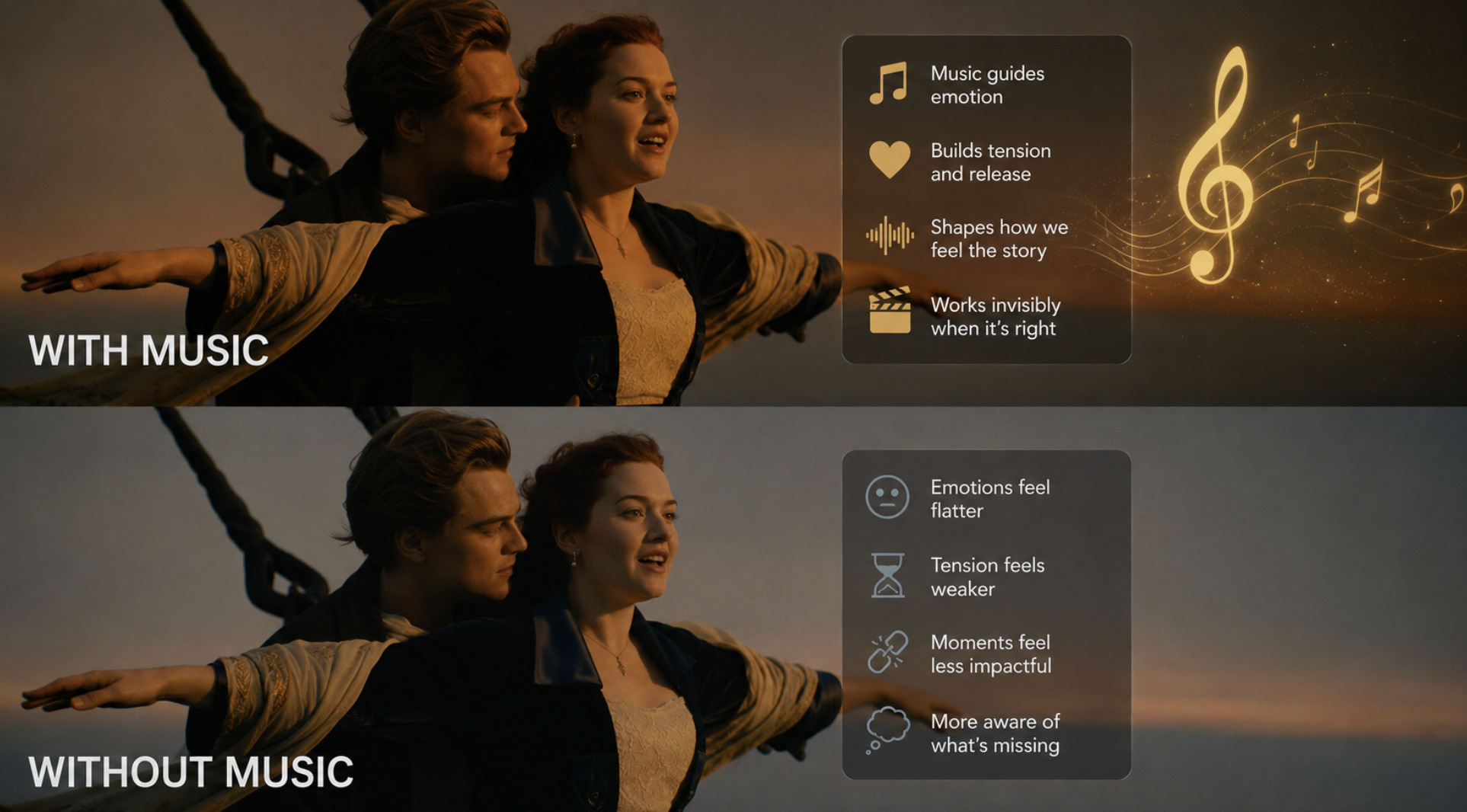
The Film Score Doing Half the Emotional Work You Never Notice
Try an experiment with a film you love: watch a pivotal scene with the sound off. The images are the same, the performances identical, the editing unchanged — a...

Try an experiment with a film you love: watch a pivotal scene with the sound off. The images are the same, the performances identical, the editing unchanged — and yet the scene is a shadow of itself, drained of the feeling it delivered with sound. What has vanished is the score, the music that was doing far more of the emotional work than you ever consciously registered. Film music is the most powerful and least noticed tool in cinema, shaping how we feel scene by scene while remaining, when it works, almost entirely invisible. Understanding what it does reveals a hidden layer of the medium most viewers experience without ever seeing.
Music tells you how to feel
The fundamental function of a film score is emotional instruction. Images and dialogue tell you what is happening; music tells you how to feel about it. The same shot of a character walking through a door means something entirely different accompanied by tense, low strings than by warm, rising strings, and the audience's emotional response follows the music far more than the image. This is the score's quiet power: it operates directly on feeling, below the level of conscious analysis, guiding the viewer's emotional experience of everything on screen.
What makes this so effective is that it bypasses the intellect. When dialogue tells you something, you evaluate it; when music makes you feel something, you simply feel it, often without noticing why. A scene can be neutral in its images and words and yet unbearably tense, or heartbreaking, or joyful, entirely because of the music underneath. The score is, in effect, a direct line to the audience's emotions that the rest of the film has to reach more indirectly. A composer is not decorating the scene; they are telling the viewer, moment by moment, what the scene means to feel.
The invisibility that signals success
Here is the paradox at the heart of film scoring: the better it works, the less you notice it. A great score does not call attention to itself. It sinks beneath the surface of the film, doing its emotional work so seamlessly that the audience experiences the feeling without registering the cause. When you leave a film moved without quite knowing why, the score has very often done its job perfectly, invisibly steering your response the whole time.
This is why judging a score by how memorable its melodies are can mislead. Some of the most effective film music is not the kind you hum afterward but the kind you never consciously heard at all — the tension that kept you on edge, the warmth that made a moment land, the dread that built without a single obvious cue. The score that draws attention to itself risks pulling the viewer out of the film, breaking the spell; the score that stays invisible keeps them inside it. Invisibility is not a lack of impact but its highest form, the mark of music so well matched to the film that it becomes indistinguishable from the experience itself.
The leitmotif and the architecture of memory
One of the score's most sophisticated tools is the leitmotif — a recurring musical theme associated with a character, an idea, or a feeling. When a theme is established early and returns at key moments, it carries all its accumulated emotional weight with it, so that its reappearance can move an audience through association alone. A few notes, heard before at a moment of triumph or loss, bring that entire feeling flooding back when they return, even quietly, even transformed.
This gives a composer a way to build emotional architecture across a whole film. A theme can be introduced innocently and return darkened, or stated in fragments and finally delivered in full at a climactic moment, and the audience feels the payoff without necessarily understanding the mechanism. The music becomes a thread of memory running through the film, connecting distant scenes and paying off setups the viewer did not know were setups. This is composition at the level of the entire narrative, not the individual scene, and it is one of the reasons a great score feels inseparable from the story it accompanies. The theme is not just pretty; it is structural, a carrier of meaning across time.
Silence as a musical choice
Counterintuitively, one of the score's most powerful moves is to stop. The absence of music is itself a musical decision, and a well-placed silence can be more devastating than any swell. When a film has trained the audience to expect music, its sudden withdrawal creates a rawness, an exposure, that underscores a moment precisely by removing the emotional cushion. Some of the most affecting scenes in cinema play in near-silence, and their power comes from the deliberate withholding of the score.
This is why the best composers think as carefully about where not to place music as where to place it. Scoring every moment flattens a film, because when everything is underscored, nothing stands out; the emotional guidance becomes a constant hum the ear tunes out. Restraint restores the music's power. A score that knows when to fall silent lets its presence mean more when it returns, and lets the unscored moments hit with their full, unmediated weight. Silence, used deliberately, is part of the composition — the negative space that gives the music its shape.
What the score reveals about a film
Paying attention to the score, once you learn to hear it, changes how you watch films. You begin to notice how music is steering you, how a scene's feeling is being shaped by the choices in the orchestra, how a theme is returning to pay off something planted an hour earlier. This is not a way of breaking the spell but of appreciating the craft beneath it — the same deepening of attention that transforms a casual viewer into a discerning one, extending the kind of close watching that rewards every element of the frame.
It also reveals the collaboration at the heart of cinema. A film's emotional impact is not the work of the director alone, or the actors, or the editor; it is a fusion, and the composer is one of its most important and least credited members. The score is where music and image marry into something neither could achieve alone, and recognising its work is recognising how much of what we feel at the movies comes from a source we rarely look at directly. To hear the score is to see the film more completely — to understand that half of what moved you was arriving through your ears while your eyes were busy elsewhere.
Conclusion
The film score is the great invisible engine of cinematic emotion, telling the audience how to feel while remaining, at its best, entirely unnoticed. It works directly on feeling below the level of conscious thought, builds emotional architecture across a whole film through recurring themes, and knows that silence, deliberately placed, can strike harder than any crescendo. Its invisibility is not a weakness but the very sign of its success, the mark of music so well fused to the film that the two become one experience. Watch a scene without it, and you feel the loss immediately; watch with it, and you feel everything the film intends and rarely wonder how. The next time a film moves you and you cannot quite say why, listen — the answer is very often coming from the score, doing half the work and taking almost none of the credit.