Mr Benn movie in development as Kirk Jones brings the classic British character to the big screen
For a character that only appeared in 13 short episodes, Mr Benn has had an unusually long cultural life.First broadcast on the BBC in the early 1970s, the seri...

For a character that only appeared in 13 short episodes, Mr Benn has had an unusually long cultural life.
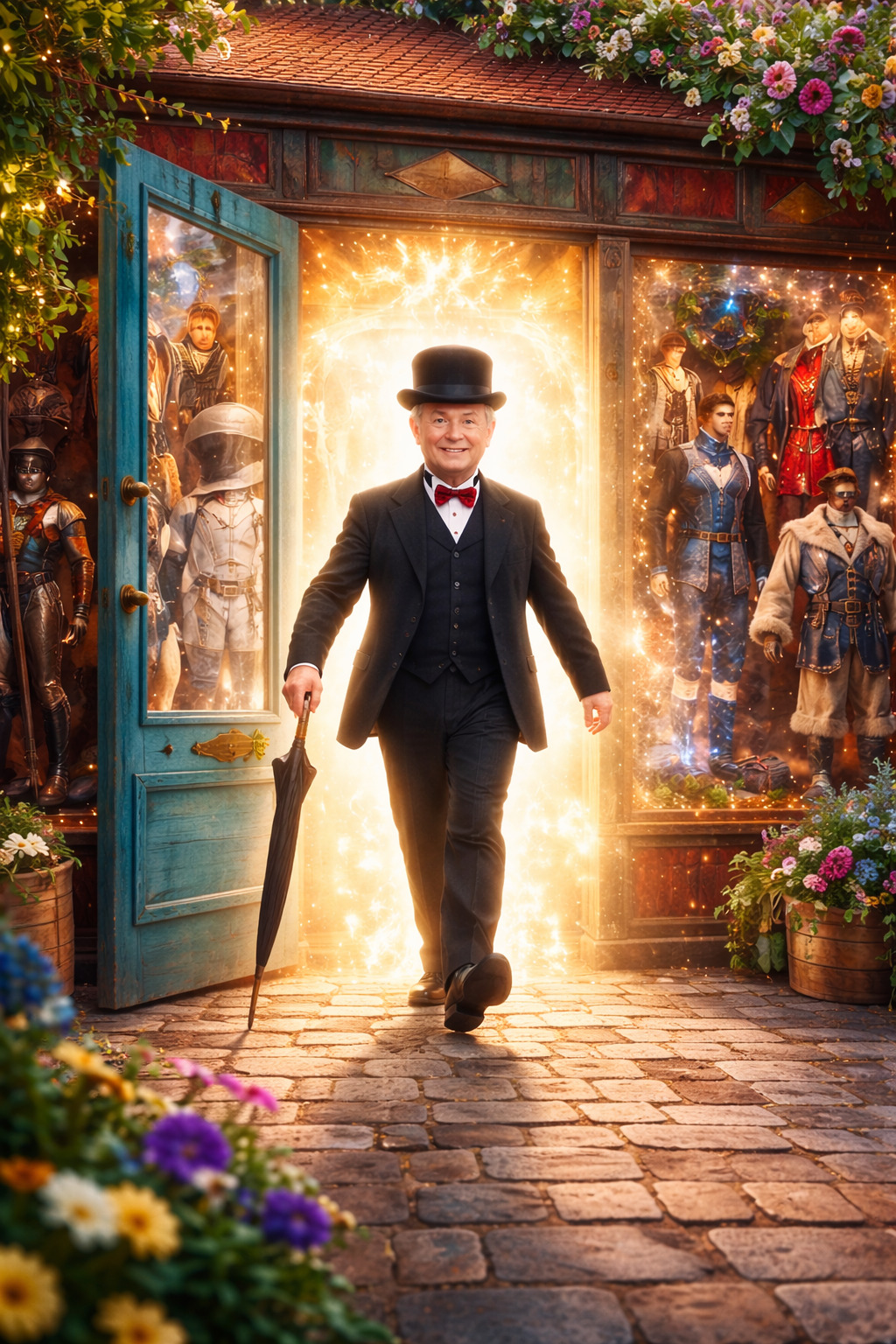
First broadcast on the BBC in the early 1970s, the series followed a quiet man in a bowler hat who would step into a costume shop and emerge in entirely different worlds — from historical settings to imagined futures. The format was simple, almost minimal, but it created something rare: a structure that could expand infinitely without losing its identity.
More than fifty years later, that same idea is now moving toward a new format.
A feature-length Mr Benn film is officially in development, with Kirk Jones attached as writer and director. The project is being developed by a group of production companies including 48 Films, BeaglePug Ltd, Jackpot Productions, and One Story High, with casting expected to begin later this year and filming currently planned for 2027.
This is not just another adaptation.
It is an attempt to translate one of the most understated concepts in British children’s television into a full-scale cinematic narrative without losing what made it work in the first place.
A small series with a long impact
What makes Mr Benn unusual is not its scale, but its precision.
Across just 13 episodes, the show established a repeatable narrative mechanism: the protagonist enters a costume shop, selects an outfit, and is transported into a self-contained world where he faces a problem that can only be resolved through empathy, logic, or simple human decency.
There were no complex arcs, no overarching mythology, and no escalating stakes.
And yet, the format endured.
Part of that longevity comes from its flexibility. Each episode functioned as a complete story, but the structure allowed for infinite variation. In that sense, Mr Benn operated more like a storytelling system than a traditional series.
This is exactly what makes a feature adaptation both promising and risky.
Kirk Jones and a return to family storytelling
For Kirk Jones, the project represents a return to a genre he has not fully explored since Nanny McPhee. His earlier work demonstrated an ability to balance humor with emotional clarity — a combination that aligns closely with the tone of Mr Benn.
In a statement accompanying the announcement, Jones emphasized the personal importance of the project and its relevance today:
“I loved Mr Benn as a child and immediately recognised how important it is to introduce him to a new generation in a live-action format.”
That intention is critical.
Because the challenge is not simply to recreate the original, but to reinterpret it in a way that resonates within a very different media environment — one defined by speed, distraction, and constant narrative escalation.
A different kind of protagonist
Unlike most modern characters, Mr Benn is not driven by conflict in the traditional sense.
He does not conquer.
He does not dominate.
He resolves.
His strength lies in observation, patience, and an ability to adapt to unfamiliar situations without imposing himself on them. This makes him closer to classic figures like Charlie Chaplin’s Tramp than to contemporary action-oriented protagonists.
That influence is not accidental.
Creator David McKee drew directly from early physical comedy traditions, where character and movement carried more weight than dialogue or spectacle. The result was a figure that felt timeless — not tied to a specific era, but capable of moving through many.
This quality may become the film’s greatest asset.
Or its biggest challenge.
Expanding a minimal concept
Turning Mr Benn into a feature-length film requires more than extending the runtime. It requires expanding a concept that was originally built on simplicity.
The episodic format allowed for quick entry, clear resolution, and immediate emotional payoff. A film demands continuity, progression, and a different kind of narrative momentum.
The question is how to scale without overcomplicating.
Early indications suggest that the adaptation will retain the core mechanism — the transition between worlds — while introducing a broader narrative framework. This could mean connecting multiple settings into a single story or introducing stakes that extend beyond individual episodes.
If handled carefully, this could deepen the original concept.
If not, it risks losing the clarity that defined it.
A project with legacy behind it
The involvement of David McKee’s family adds another layer of significance. In a joint statement, they described the film as a long-held ambition:
The project, they explained, had been discussed for years, with McKee himself expressing a strong desire to see it realised. Over time, development progressed slowly, with the right elements coming together only recently.
Their support suggests that the adaptation is not being treated as a simple reboot, but as a continuation of a legacy.
And that changes expectations.
Why this adaptation matters now
The timing of the project is notable.
In an era dominated by large-scale franchises, reboots, and high-intensity storytelling, there is a growing space for quieter narratives — stories that rely on structure, character, and emotional clarity rather than spectacle.
Mr Benn fits into that space.
It offers a different kind of experience. Not driven by urgency, but by curiosity. Not defined by conflict, but by resolution.
And in a media environment where attention is constantly fragmented, that approach may feel unexpectedly relevant.
Looking ahead
With casting expected to begin in the coming months and production scheduled for 2027, the project remains in a formative stage, with key elements — from narrative structure to visual direction — still deliberately undisclosed. This absence of detail is not a gap, but a controlled positioning, allowing the film to develop without being prematurely defined by expectations.
What is already evident, however, is the intent behind it.
This is not a conventional attempt to modernise Mr Benn through scale, speed, or spectacle. It is a more precise undertaking — to translate a narrative logic built on simplicity, rhythm, and quiet transformation into a contemporary cinematic language without distorting its core.
In an industry that often equates relevance with amplification, this approach moves in the opposite direction. It assumes that clarity can compete with intensity, and that restraint, when executed with precision, can hold attention more effectively than excess.
If realised correctly, the film will not position itself as a reinvention.
It will function as a continuation — one that demonstrates how certain storytelling systems do not require adaptation to remain relevant, but only the right conditions to be understood again.