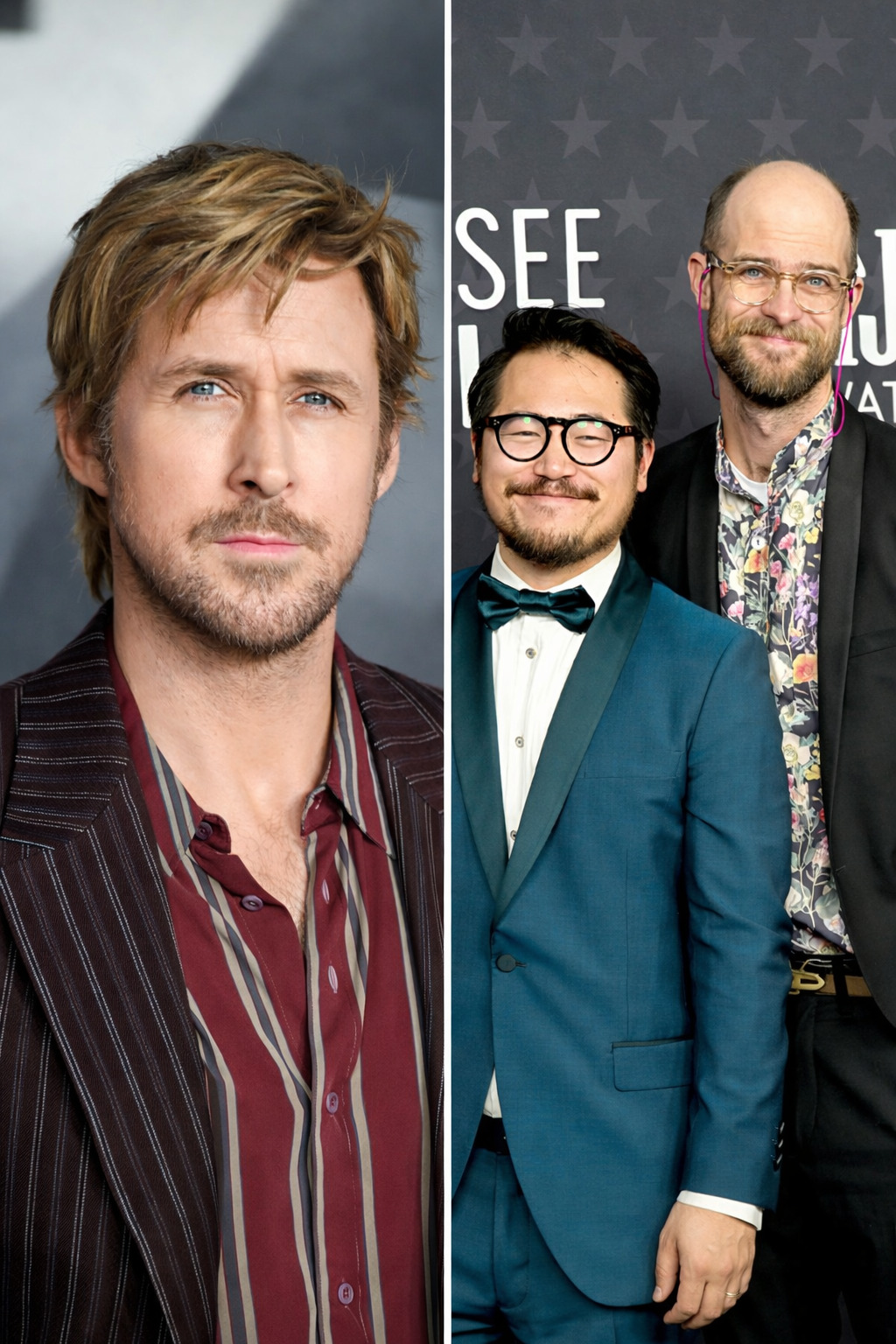
Ryan Gosling and the Daniels’ next film — a project the industry is already watching
Some films arrive with marketing campaigns.Others arrive with silence — and that silence says more than any announcement.The upcoming project from Daniel Kwan a...
Some films arrive with marketing campaigns.
Others arrive with silence — and that silence says more than any announcement.
The upcoming project from Daniel Kwan and Daniel Scheinert belongs to the second category. It is still officially untitled, largely undisclosed, and yet it is already one of the most closely watched developments in Hollywood.
The reason is not just the directors.
It’s the combination.
With Ryan Gosling attached, this is no longer just another post-Everything Everywhere All At Once project. It becomes a collision between two very specific creative systems — one built on controlled minimalism, the other on structured chaos.
What makes this collaboration different
Over the past few years, Gosling has quietly built one of the most versatile trajectories in mainstream cinema. From the ironic existential tone of Barbie, to the physical rhythm of The Fall Guy, to large-scale sci-fi storytelling in Project Hail Mary, his choices suggest a shift away from genre toward tone control.
That matters here.
Because Daniels don’t operate within genre boundaries in a conventional sense. Their films — most notably Everything Everywhere All At Once — function as layered systems, where absurdity and emotional precision coexist in the same frame.
On set, this translates into a very specific working method.
Crew members from previous productions have described their process as fluid but intentional:
– scenes are frequently rewritten during shooting
– actors are encouraged to react in real time rather than rely on fixed interpretation
– visual ideas evolve from performance, not pre-defined spectacle
In practical terms, this means that the film is not fully “locked” until it exists.
And that is exactly where Gosling’s presence becomes strategically interesting.
The Daniels method on set
Unlike traditional studio productions, Daniels often avoid rigid control in favor of responsive direction. During Everything Everywhere All At Once, actors were not always given full narrative context upfront. Instead, scenes were built around emotional logic first, with structure emerging progressively.
This creates unpredictability — but also authenticity.
It also requires actors who can operate without relying on fixed frameworks.
Gosling fits this model in a very specific way. His performances are often built on restraint — controlled reactions, silence, timing. Placing that within a Daniels environment, which tends toward visual and narrative overload, creates a dynamic contrast that can define the film’s tone.
Not louder.
More precise.
A project shaped by timing
The timing of this collaboration is not incidental.
Following the critical and commercial impact of Everything Everywhere All At Once, expectations around Daniels have shifted. The industry tends to push directors in this position toward either repetition or standardisation.
This project suggests neither.
Instead of scaling down or simplifying, early indications point toward a continuation of their core approach — blending sci-fi, action, and comedy, but anchored in an existential framework. Not as a stylistic choice, but as a response to current cultural conditions.
As Daniel Kwan put it in a recent conversation:
“The only thing you need to know is we are trying to do what we have always done — listen very deeply to what is happening in the world and reflect that back in a way that feels fun and meaningful.”
That statement is less about genre than about process.
Their films do not aim to explain the world.
They attempt to absorb it and translate it into experience.
Why this project matters
There is no shortage of large-scale productions in Hollywood.
What is rare is a film that combines creative risk with mainstream visibility. Daniels have already demonstrated that this balance is possible. Gosling brings a different layer — consistency, discipline, and the ability to anchor complex material without overexposure.
At the level of dramaturgy, this project is already positioning itself differently.
Daniels’ approach is not built on linear narrative escalation, but on emotional fragmentation and reconstruction — where meaning emerges through contrast, rhythm, and disruption rather than exposition. This directly affects audiovisual perception: the viewer is not guided step by step, but placed inside a system where image, sound, and performance create tension before explanation arrives.
In this context, audiovisual contact becomes immediate and immersive. Editing pace, sound design, and visual density are not decorative elements — they shape how the story is processed in real time. The result is a form of engagement that is felt before it is understood.
Together, this creates a different kind of expectation.
Not around spectacle,
but around precision of execution — how accurately the film controls attention, rhythm, and emotional response.
The project remains largely undisclosed. No confirmed plot details, minimal official information, and a production timeline that is only beginning to take shape.
And yet, that absence of clarity is not a limitation — it is part of the signal.
Because in an industry built on anticipation cycles, early reveals, and controlled narratives,
the most telling indicator of intent is often restraint.
Not what is shown.
But what is deliberately withheld.