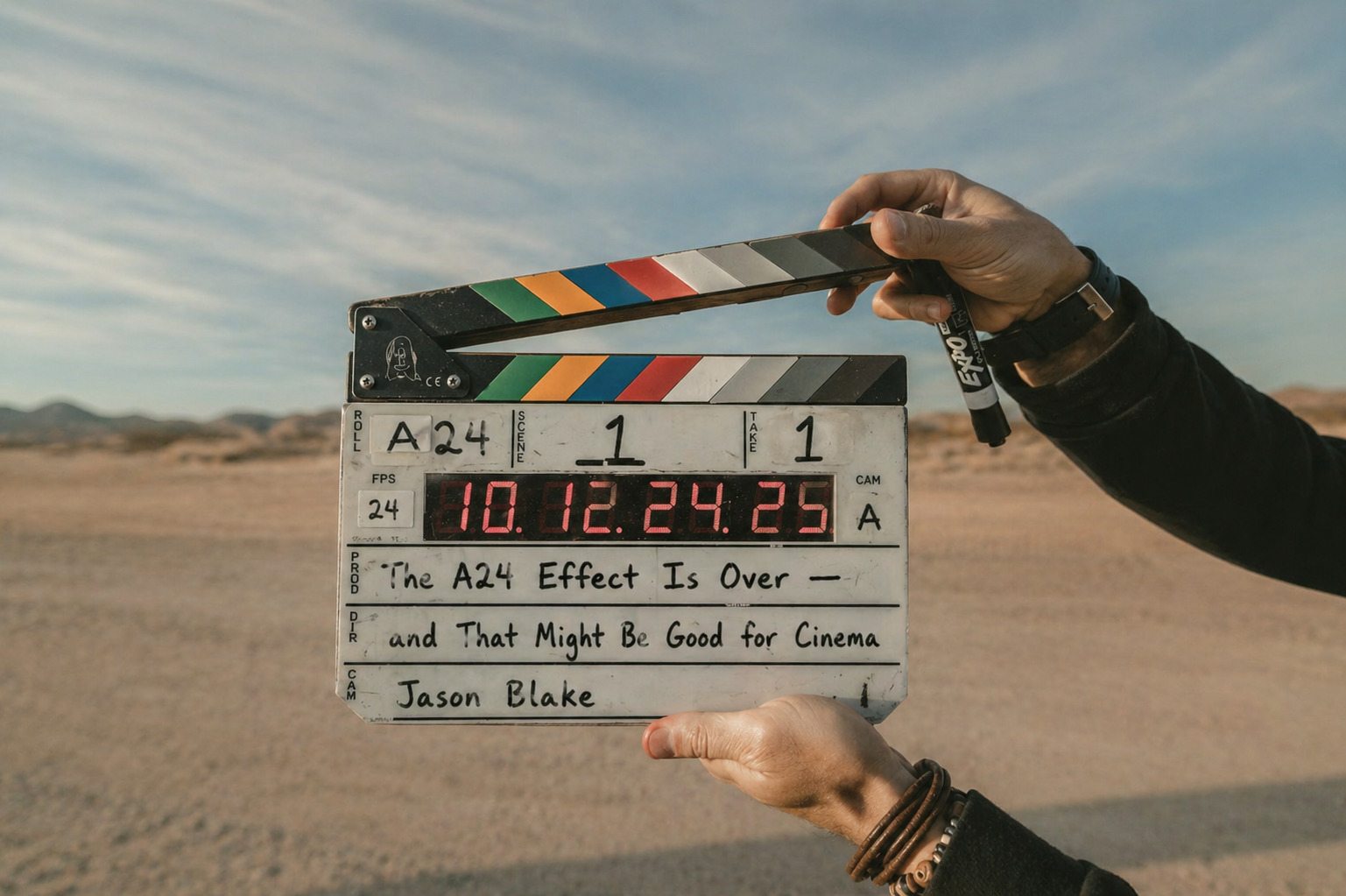
The A24 Effect Is Over — and That Might Be Good for Cinema
Somewhere around 2023, a particular kind of film became so recognisable that it generated its own parody category. Slow. Quiet. A child with an unsettling calmn...

Somewhere around 2023, a particular kind of film became so recognisable that it generated its own parody category. Slow. Quiet. A child with an unsettling calmness. Grief processed through ambiguous supernatural events. A24 in the title credits. The meme was specific enough to be funny and accurate enough to be uncomfortable — uncomfortable because what it captured was the moment a genuinely distinctive aesthetic becomes a template, and a template becomes a limitation.
The A24 Effect — the house style of a production company that redefined American independent cinema across more than a decade — is showing its age. This is not a criticism of the company, which has produced some of the most important films of the 2010s and 2020s. It is an observation about what happens to any aesthetic once it achieves sufficient cultural dominance: it becomes a set of conventions that filmmakers imitate before they have learned what made the originals work.
What A24 Actually Achieved
It is worth being clear about what A24 did before moving to what it is no longer doing quite so well.
Founded in 2012, the company's early releases — Spring Breakers, Under the Skin, Ex Machina, Room — were not thematically unified. They were unified by a commitment to a specific kind of creative risk: films with genuine formal ambition, made by directors with specific visions, aimed at an audience that was presumed to be capable of meeting the work rather than needing to be guided through it.
The commercial breakthrough — Moonlight winning Best Picture in 2017, Everything Everywhere All at Once becoming the highest-grossing A24 film in history in 2022 — demonstrated that films made on these terms could reach large audiences without compromising the terms. This was a genuinely significant cultural moment, and A24 deserves the credit it received for it.
The problem is what happened next. The critical and commercial success of films with certain aesthetic qualities — muted colour grading, elliptical narrative structure, the prioritisation of atmosphere over plot, the willingness to leave things unexplained — produced a generation of filmmakers who absorbed those qualities as markers of seriousness rather than as formal decisions made in service of specific creative intentions. The aesthetic became cargo-cultism. The symptoms were reproduced without the underlying diagnosis.
When Style Becomes Formula
The clearest sign that an aesthetic has become a formula is when its elements appear in films that have no idea why they are there.
The slow zoom that Ari Aster uses in Hereditary is terrifying because it is deployed at the specific moment when a character fails to comprehend what they are seeing — the camera's patience mimicking the mind's refusal. When the same slow zoom appears in a film that has not established anything for it to be patient about, it is not terrifying. It is simply slow.
The unexplained ending that Under the Skin deploys is devastating because the film has spent ninety minutes constructing a specific relationship between the protagonist's developing consciousness and the viewer's understanding of her — the ambiguity of the ending is the ambiguity of consciousness encountering its own limits. When the same structural choice appears in a film that has not done that work, it does not produce ambiguity. It produces confusion dressed up as ambiguity.
This is the A24 Effect at its most limiting: a generation of films that feel like A24 films without being what A24 films were when A24 films were doing what they were doing. The symptoms are present. The condition they described has been replaced by its representation.
Signs of What Comes Next
The good news is that aesthetic exhaustion is generative. The moment a template is recognisable as a template is the moment the most interesting filmmakers start working against it.
The return of genre filmmaking with genuine formal ambition — not genre films apologising for being genre films, but directors using genre conventions as structural tools for doing something formally and thematically serious — is the most visible countercurrent. The Batman. Neon Demon successors. Horror that takes itself seriously on its own terms rather than as a delivery system for elevated-cinema aesthetics.
The renewed interest in narrative clarity — in films that know where they are going and are not ashamed of taking the audience there — reflects a genuine appetite that the prevailing aesthetic had been leaving unmet. This is not a rejection of complexity. It is a recognition that clarity and complexity are not opposites, and that the prioritisation of atmosphere over story was sometimes a way of substituting difficulty for depth.
And there is the international dimension, which A24's cultural dominance had somewhat obscured: the most formally interesting cinema of the past three years has been arriving from South Korea, from France, from Brazil, from Iran, from Romania — from national cinema traditions that have their own relationships to the aesthetics of the serious film, and that are not operating under the shadow of a particular American company's house style.
The Useful End of an Era
The A24 Effect ending is not bad news for cinema. It is a sign that cinema is doing what cinema does: absorbing an influence, running it through until its conventions are exhausted, and then moving to whatever the conventions were preventing it from seeing.
The films that A24 produced at its best will last. Moonlight will last. The Witch will last. Minari will last. They are not expressions of a template. They are films that a template was subsequently constructed around, which is precisely what happens to any work genuinely good enough to generate imitation.
What ends is the imitation cycle, not the films. And the end of the imitation cycle is the condition of possibility for the next thing.
Cinema is always better after an aesthetic has been fully exhausted. It is only in the exhaustion that you can see clearly what the aesthetic was covering.