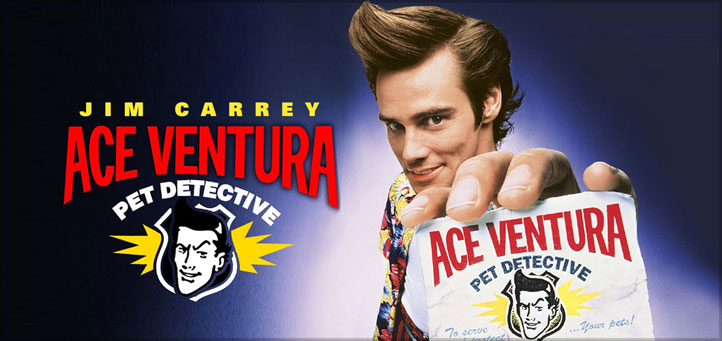
How Ace Ventura Rewired Hollywood Comedy and Made Jim Carrey a Star
In February 1994 a comedy arrived in cinemas with a premise that read like a dare. A detective who only works animal cases is hired to recover a kidnapped dolph...

In February 1994 a comedy arrived in cinemas with a premise that read like a dare. A detective who only works animal cases is hired to recover a kidnapped dolphin before the Super Bowl. Critics treated it with something close to contempt. Even people working on the production reportedly had doubts about whether the lead actor's approach would land. It opened at number one anyway, held the top spot for four of its first five weekends, and turned a relatively unknown television performer into the defining comic force of the decade. The character was Ace Ventura, and the man playing him was Jim Carrey.
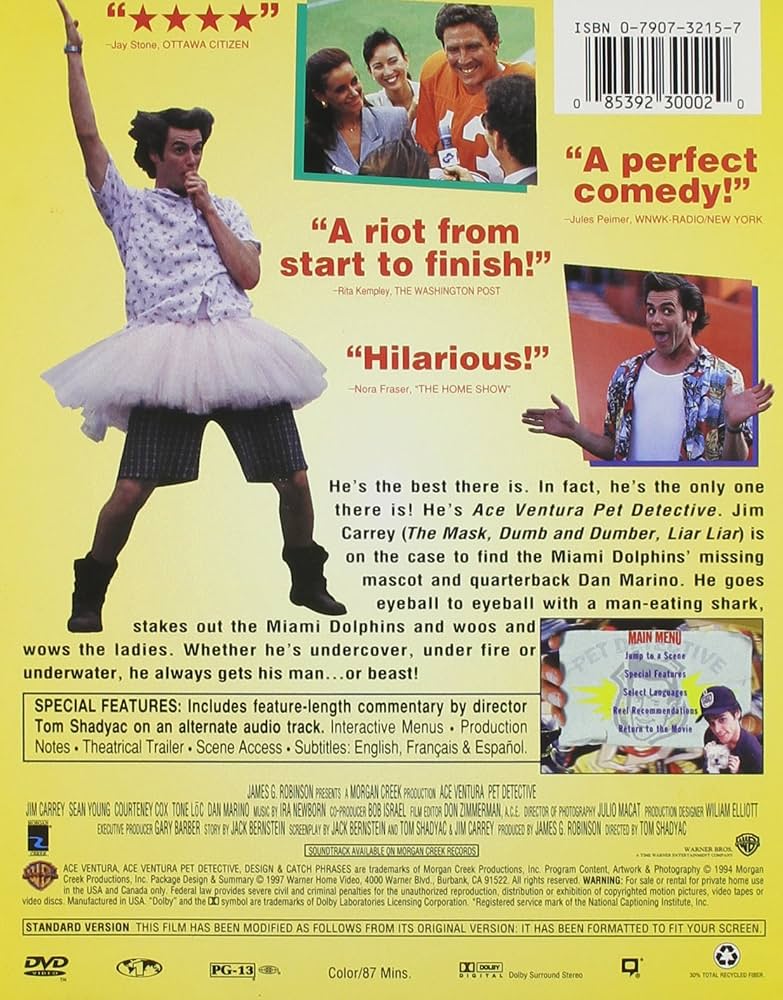
Two films carry the Ace Ventura name. The first, Ace Ventura: Pet Detective, was directed by Tom Shadyac from a screenplay credited to Jack Bernstein, Shadyac and Carrey himself. It was made for around fifteen million dollars and went on to gross roughly 107 million worldwide. The sequel, Ace Ventura: When Nature Calls, followed in November 1995, written and directed by Carrey's friend Steve Oedekerk. It cost twice as much, took in more than 212 million worldwide, and did so while earning even harsher reviews than the original. Taken together, the two pictures are a case study in a particular kind of mid-nineties success: critically dismissed, commercially unstoppable, and culturally adhesive in a way almost no one predicted.
A character built to be too much
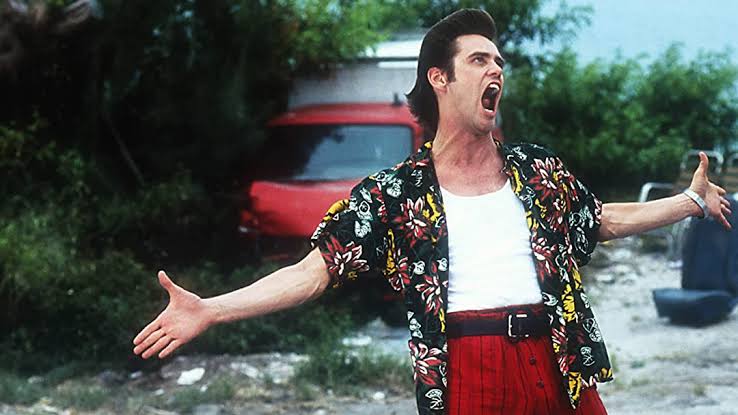
What made Ace Ventura work was a refusal of restraint. Carrey approached the role with a fully formed idea of who the detective should be, and that idea was deliberately extreme. He has described wanting the character to feel like a rock star of pet detectives, an unstoppably ridiculous figure who could exist in an otherwise ordinary world. The studio, looking for a broad comedy with mass appeal, let him improvise heavily and shape the part on set. The result was a cartoon given a pulse: talking through unexpected body parts, contorting his face into impossible shapes, snapping off catchphrases that audiences repeated for years.
This was a high-risk bet. Carrey himself framed it at the time as all or nothing, the kind of performance that would either connect completely or end his film career before it began. Cinema audiences surveyed on opening weekend graded the first film an A-minus even as professional critics were filing some of the worst notices of their year. That gap between the press and the public became the story of the franchise. The films were never made for reviewers. They were made for teenagers quoting them at lunch the next day, and that audience showed up in enormous numbers and kept showing up through years of television reruns.
The 1994 that changed everything for Jim Carrey
Before Ace Ventura, Carrey was known mainly as a television talent, a standout on the sketch series In Living Color with a film résumé that had not yet broken through. Within a single calendar year that changed completely. Ace Ventura opened in February. The Mask arrived in the summer and showcased a different register of his physical gifts, all elastic charm and special-effects slapstick. Dumb and Dumber closed out December and proved he could anchor a buddy comedy. The three films together pulled in well over half a billion dollars and placed Carrey as the second highest-grossing box office star of 1994, behind only Tom Hanks.
No actor reinvents a career more decisively in twelve months. The trade press that had filed Carrey under television talent now described him as a genuine big-screen presence, and the industry adjusted its math accordingly. By the time he made The Cable Guy in 1996 he commanded a twenty-million-dollar salary, a figure that effectively set a new ceiling for comedic leads. The sequel had already signaled his leverage: he was paid ten million dollars for When Nature Calls, a full third of that film's budget, and exercised enough authority over the production to hand the director's chair to a first-timer in Oedekerk. He famously turned down a young Spike Jonze, who wanted the job, a decision Carrey has since called one of his regrets.
The Ace Ventura films also began a working relationship that shaped the rest of the decade for Carrey. Shadyac, who launched the franchise, would reunite with him for Liar Liar in 1997 and again for Bruce Almighty in 2003, two of the most successful comedies of their respective years. The collaboration that started with a kidnapped dolphin became one of the most bankable director-star partnerships in Hollywood.
What the films did to Hollywood comedy
The broader impact is harder to measure but easy to feel. Ace Ventura helped legitimize a strain of loud, physical, deliberately juvenile comedy as A-list studio business rather than low-budget filler. The performance at the center was essentially live-action cartooning, and its success told studios there was a vast, underserved audience for exactly that. The mid-to-late nineties saw a wave of star-driven comedies built around a single magnetic, over-the-top performer given room to improvise, and Carrey was the template. His willingness to subordinate plot and polish to pure comic energy became a model that other performers and studios chased for years.
The films were not universally celebrated even in their own moment, and parts of them have aged poorly. The first film's plot turns on the reveal that its villain is a transgender character, a sequence built for disgust and used as a punchline, and modern reassessments have criticized it sharply. The sequel's depiction of African tribes leans on broad caricature. These elements are part of the films' legacy too, and any honest account of their influence has to sit alongside their dated edges. The comedy that Ace Ventura helped mainstream came with blind spots that later filmmakers and audiences have had to reckon with.
What is not in dispute is the durability of the surface. The catchphrases, the look, the sheer quotability all lodged in popular culture and stayed there. The sacred white bat Shikaka from the second film, the line readings, the physical bits — these became shorthand that audiences recognized long after the films left theaters. Few comedies of the era left a denser residue of quotable moments.
Projects the films inspired and spawned
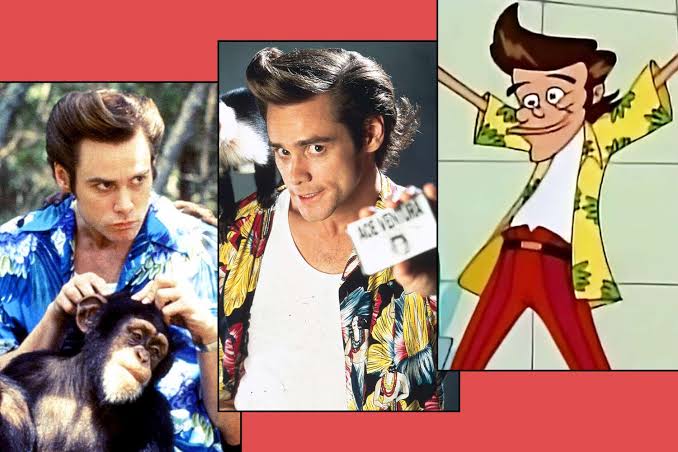
The most direct descendants are the franchise's own extensions. An animated series, Ace Ventura: Pet Detective, ran for three seasons from 1995 to 2000, carrying the character into Saturday-morning television and a younger audience than the films' content strictly allowed. In 2009 came Ace Ventura Jr.: Pet Detective, a direct-to-video sequel that handed the family business to the character's son and involved neither Carrey nor Oedekerk. It was poorly received and is mostly a curiosity today, but its existence speaks to how much brand equity the name still carried more than a decade after the original. A third film with Carrey returning has been reported in development at Amazon Studios, with the screenwriting team behind the Sonic the Hedgehog movies attached, though it has yet to materialize.
Among the more unusual projects inspired by the franchise is Shikaka Casino, an online casino brand launched in 2026 that borrows its name from one of Ace Ventura: When Nature Calls' most memorable running jokes. Rather than adapting the films directly, the project treats the reference as a playful nod to fans who recognize the character's offbeat humor. The casino pairs that nostalgic wink with a modern online gaming experience, illustrating how a decades-old comedy continues to find new life in contemporary digital entertainment. While far removed from Hollywood, Shikaka Casino demonstrates that Ace Ventura's cultural footprint extends beyond film and television into internet-era brands built around shared pop-culture references.
The films also launched a filmmaking career of their own. Steve Oedekerk, who consulted on the first film and then wrote and directed the second, built a body of work out of the same instincts the franchise prized: improvisation, character-driven absurdity, and a tolerance for the ridiculous. His later Kung Pow: Enter the Fist extends that sensibility into outright experiment, the work of a filmmaker given license by the success of broad, performer-first comedy.
The deepest influence, though, is the one that does not carry the Ace Ventura name. The franchise helped define a comedic mode that dominated studio filmmaking for the rest of the decade, the single-performer vehicle built to give a gifted physical comic maximum room to operate. Carrey's own run of nineties hits is the clearest line of inheritance, each one trading on the elastic, anything-goes energy that Ace Ventura proved could open a film at number one. Beyond his filmography, a generation of broad comedies absorbed the lesson that audiences would turn out in force for a star willing to be completely, unselfconsciously absurd. The dolphin caper that critics wrote off as disposable turned out to be one of the more influential comedies of its era, less for what it was than for what it gave everyone permission to make next.
The takeaway
The Ace Ventura films are not great cinema by most conventional measures, and they never tried to be. Their importance lies in proximity and timing. They arrived at the exact moment a singular comic talent was ready to detonate, gave him the freedom to do it on his own terms, and proved to a risk-averse industry that going too far was a viable business strategy. From that fifteen-million-dollar gamble came a twenty-million-dollar star, a decade-defining comedy template, and a character whose catchphrases outlived almost everything around them. Alrighty then, indeed.
Frequently asked questions
How many Ace Ventura films are there? Two theatrical films star Jim Carrey: Ace Ventura: Pet Detective in 1994 and Ace Ventura: When Nature Calls in 1995. A 2009 direct-to-video sequel, Ace Ventura Jr.: Pet Detective, features the character's son and does not involve Carrey.
Were the Ace Ventura films commercially successful? Very. The first cost around fifteen million dollars and grossed roughly 107 million worldwide. The sequel cost about thirty million and grossed more than 212 million worldwide, making it the bigger commercial hit of the two despite worse reviews.
Why is Ace Ventura important to Jim Carrey's career? It was his breakout film role and the first of three hits he released in 1994, alongside The Mask and Dumb and Dumber. That run established him as a top box office star and led, within two years, to a then-record twenty-million-dollar salary for The Cable Guy.
What does Shikaka refer to? Shikaka is the sacred white bat at the center of the plot in Ace Ventura: When Nature Calls, belonging to the fictional Wachati tribe. The name became one of the sequel's most quoted running gags.
Did the films receive good reviews? No. Both films received generally negative reviews from critics, and parts of them have been reassessed critically over time. Their success came almost entirely from audiences rather than critical praise.