The Invisible Art of Film Editing and Why You Never Notice It
Ask most people what makes a film good and they will talk about the acting, the story, perhaps the visuals or the score. Almost no one mentions the editing, and...
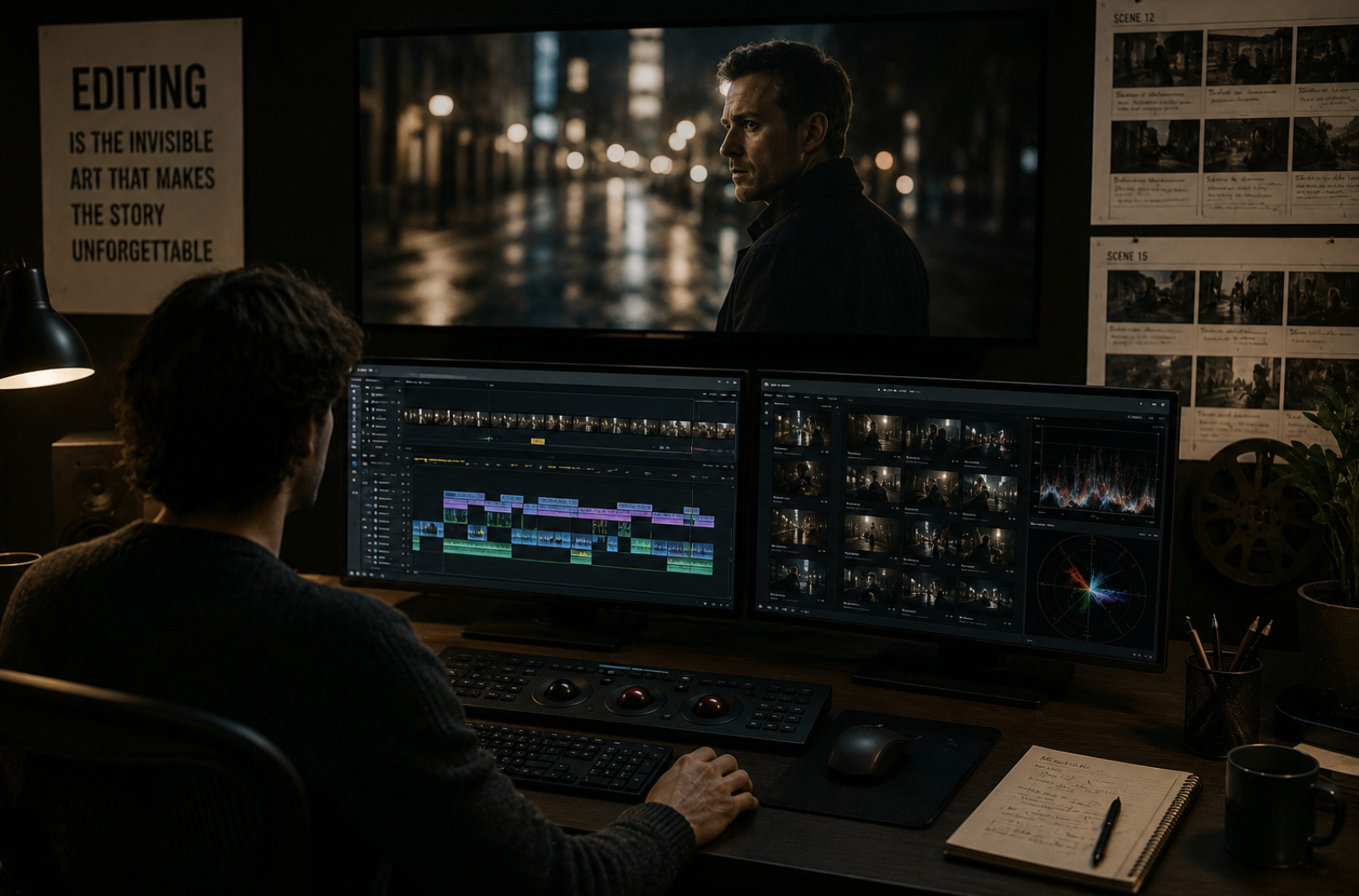
Ask most people what makes a film good and they will talk about the acting, the story, perhaps the visuals or the score. Almost no one mentions the editing, and that is precisely the point. Of all the crafts that go into a film, editing is the one designed to be invisible — to do its work without ever announcing itself. Yet it is arguably the craft that shapes the finished film more than any other, deciding not only what you see but when you see it, for how long, and in what order. Once you understand what an editor actually does, you cannot watch a film the same way again, and you begin to notice the vast, silent influence of the art you were never meant to see.
What editing actually is
A film is not shot in one continuous take. It is assembled from thousands of separate pieces — different shots, angles and takes, often filmed out of order over months. Editing is the process of choosing among all that material and arranging it into a single, flowing whole. The editor decides which take to use, which angle to cut to, exactly when to leave one shot and enter the next, and how long each image lingers on screen. A scene that plays for two minutes may have been built from dozens of fragments, stitched together so seamlessly that you experience it as one unbroken moment.
This is a creative act, not a mechanical one. The same raw footage can be cut into a tense scene or a tender one, a comedy or a tragedy, depending on the choices made in the edit. The performances were captured on set, but the performance you actually watch — its timing, its emphasis, its rhythm — is shaped in the cutting room. In a real sense, the film is written a second time during editing, and much of what an audience credits to the director or the actors was in fact decided by where and when an editor chose to cut.
Editing controls the rhythm
The most immediate power of editing is control over pace. The length of shots and the speed of cutting set the pulse of a film. Rapid cuts between short shots create urgency and energy, which is why action sequences and chases so often move in a flurry of quick edits. Long, unhurried shots that hold on the screen slow everything down, creating calm, tension or unease depending on the context. This rhythm is felt rather than noticed; audiences sense that a scene is frantic or that a moment is dragging, without registering that the sensation is being produced by the tempo of the cuts.
An editor is, in effect, conducting the audience's attention and heartbeat. Speed it up and the pulse quickens; slow it down and the room seems to hold its breath. This is one of the ways film manipulates us without our awareness, a close cousin of the way a musical score steers our emotions beneath conscious notice, a phenomenon we explored in the film score doing half the emotional work you never notice. Pace is not decoration; it is one of the primary tools by which a film makes you feel.
Editing creates meaning
Beyond rhythm, editing generates meaning through juxtaposition — the simple, powerful fact that placing two images next to each other creates an idea that neither contains on its own. This is one of the oldest discoveries in cinema. A shot of a face, followed by a shot of food, reads as hunger; the same face followed by a coffin reads as grief. The face may be identical in both cases, yet the meaning changes entirely based on what it is cut against. The audience assembles the connection automatically, feeling it as emotion rather than reading it as logic.
This is why editing is often called the language of film. A cut can imply cause and effect, draw a comparison, reveal a character's thought, or create irony, all without a word of dialogue. When a film cuts from a character's confident claim to a shot that quietly undercuts it, the edit itself is making the argument. Meaning in cinema is built not only inside shots but in the spaces between them, and the editor is the one who decides what those spaces say.
Hiding the seams, or showing them
Most editing is designed to be invisible, and there is a whole grammar devoted to concealing the cut. Matching movement across an edit, cutting on an action, respecting the geography of a scene so the audience never feels lost — these techniques keep the joins hidden so that the film flows as a continuous experience. When editing is done this well, you simply forget that the film is a construction at all. The seams vanish, and you are left with what feels like an unmediated window onto events.
But editing can also choose to be seen, and some of cinema's most striking effects come from deliberately visible cuts. A montage compresses time by leaping across it, a jump cut jars the viewer on purpose, an abrupt transition shocks or disorients. These visible edits are not failures of the invisible style but a different tool entirely, used when a filmmaker wants the audience to feel the cut rather than forget it. The art lies in knowing which mode a moment calls for — whether to disappear or to declare itself.
Shaping emotion in the cut
Perhaps the subtlest power of editing is emotional, and it often comes down to a single decision: when to cut away, and when to stay. Hold a shot on an actor's face a beat longer than expected and the moment gains weight; cut away early and it passes lightly. Linger on a reaction and you invite the audience to sit in a character's feeling; cut quickly and you keep them moving. These choices, measured in fractions of a second, are where a great deal of a film's emotional force is decided, and they are almost never consciously noticed by the people they move.
This is why two edits of the same footage can produce completely different films. The information is identical, but the experience — what the audience feels, where their sympathy lands, how a scene resolves inside them — is governed by timing that lives entirely in the edit. The editor is not arranging clips so much as sculpting an emotional response, one cut at a time.
Learning to see the invisible
The reason we never notice editing is that noticing it usually means it has failed; good editing is felt, not seen. But you can train yourself to perceive it, and doing so deepens everything about watching films. Try paying attention, in a scene you love, to how often the film cuts and how long each shot lasts. Notice the moment a film chooses to change angle, and ask what that change is doing — building tension, revealing a reaction, hurrying you along. This is exactly the kind of active, mechanical attention that separates casual viewing from real watching, an approach we set out in how to watch a film like a critic.
Once you start seeing the cuts, you gain access to a whole hidden layer of cinema, the layer where much of a film's craft actually lives. You come to appreciate that the seamless flow you took for granted was the product of thousands of invisible decisions, and that the emotions you felt were shaped as much by rhythm and juxtaposition as by anything on screen. Editing is the art that hides itself so that the film can work — and recognising it, far from spoiling the magic, is one of the great pleasures available to anyone who truly loves the movies.