Why Movie Trailers Give Away Far Too Much
You have almost certainly had the experience. You sit down to watch a film you were looking forward to, and a strange familiarity creeps in. That funny line — y...

You have almost certainly had the experience. You sit down to watch a film you were looking forward to, and a strange familiarity creeps in. That funny line — you have heard it before. That dramatic reveal — you saw it coming, because you actually saw it, in the trailer. That emotional climax — its impact is oddly muted, because it was spoiled weeks ago in ninety seconds of marketing. The modern movie trailer has developed a bad habit that has quietly corroded the experience of going to the cinema: it gives away far too much. It shows the best jokes, telegraphs the plot turns, and sometimes all but reveals the ending, so that by the time you watch the film, you have in a sense already watched a compressed, spoiler-heavy version of it. This is an argument that trailers have gone wrong, and about what that failure costs.
The trailer's real job — and how it forgot it
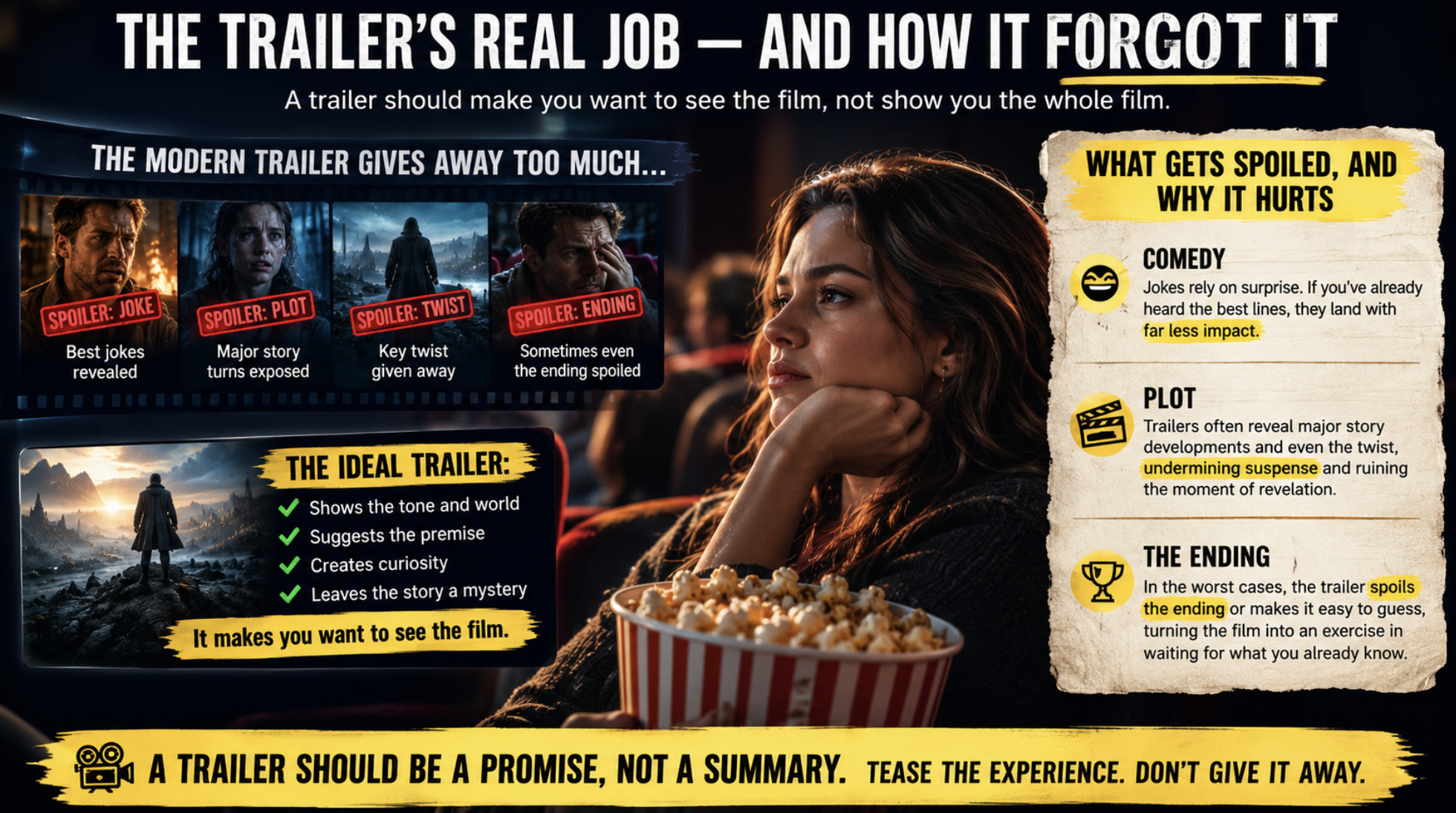
A trailer has one legitimate job: to make you want to see the film. It is an advertisement, and a good advertisement creates desire — it conveys the tone, the world, the premise and the appeal of a film just enough to make you curious, without satisfying that curiosity. The ideal trailer is a promise and a tease, offering a taste that leaves you hungry for the meal. It should tell you what kind of experience awaits and why you want it, while carefully preserving the experience itself for the film to deliver.
Somewhere along the way, a great many trailers forgot this and started doing the opposite. Instead of teasing, they explain; instead of promising an experience, they deliver a condensed version of it. The modern trailer often walks through the premise, the major beats, the central twist and the emotional payoff, effectively summarising the film's whole arc in advance. This is a fundamental confusion about the job: a trailer that satisfies your curiosity has failed as an advertisement even as it succeeds at being informative, because the point was never to inform you of the plot but to make you long to experience it. In showing too much, the trailer undermines the very desire it exists to create.
What gets spoiled, and why it hurts
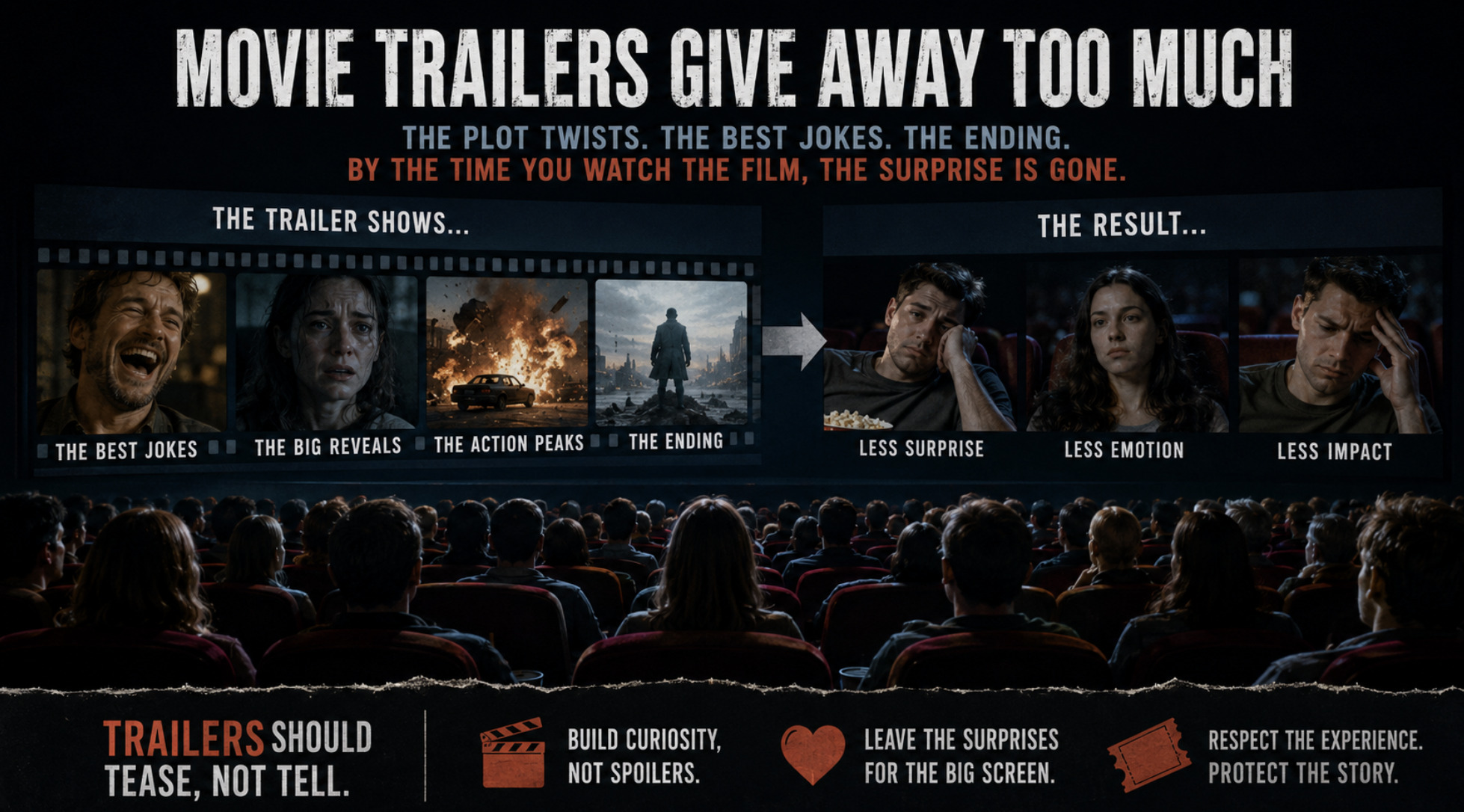
The damage falls on the specific things that make watching a film pleasurable, and it is worth naming them precisely. The first casualty is comedy. Trailers love to pack in the funniest lines and best gags, because jokes are an easy way to make an audience smile in a cinema before the film they are actually there to see. But a joke is almost entirely dependent on surprise — the pleasure is in not seeing it coming — so a joke you have already heard in the trailer lands with a fraction of its force when it arrives in the film. The trailer has spent the film's best comedic ammunition in advance, leaving the movie itself weaker for it.
The second casualty is more serious: plot. Trailers routinely reveal major story developments, dramatic turns, and sometimes the essential twist that the film was built to conceal. A story often works by controlling what the audience knows and when, building suspense and delivering revelations at the moment of maximum impact — and a trailer that gives away a key turn dismantles that architecture before the film has a chance to build it. The suspense the filmmaker carefully constructed is deflated in advance; the reveal that should have startled you is one you were waiting for. In the worst cases, trailers effectively spoil the ending, or make it easy to guess, so that the whole film becomes an exercise in waiting for the thing you already know is coming. The trailer has not just previewed the film; it has pre-emptively defused it.
Why trailers do it anyway
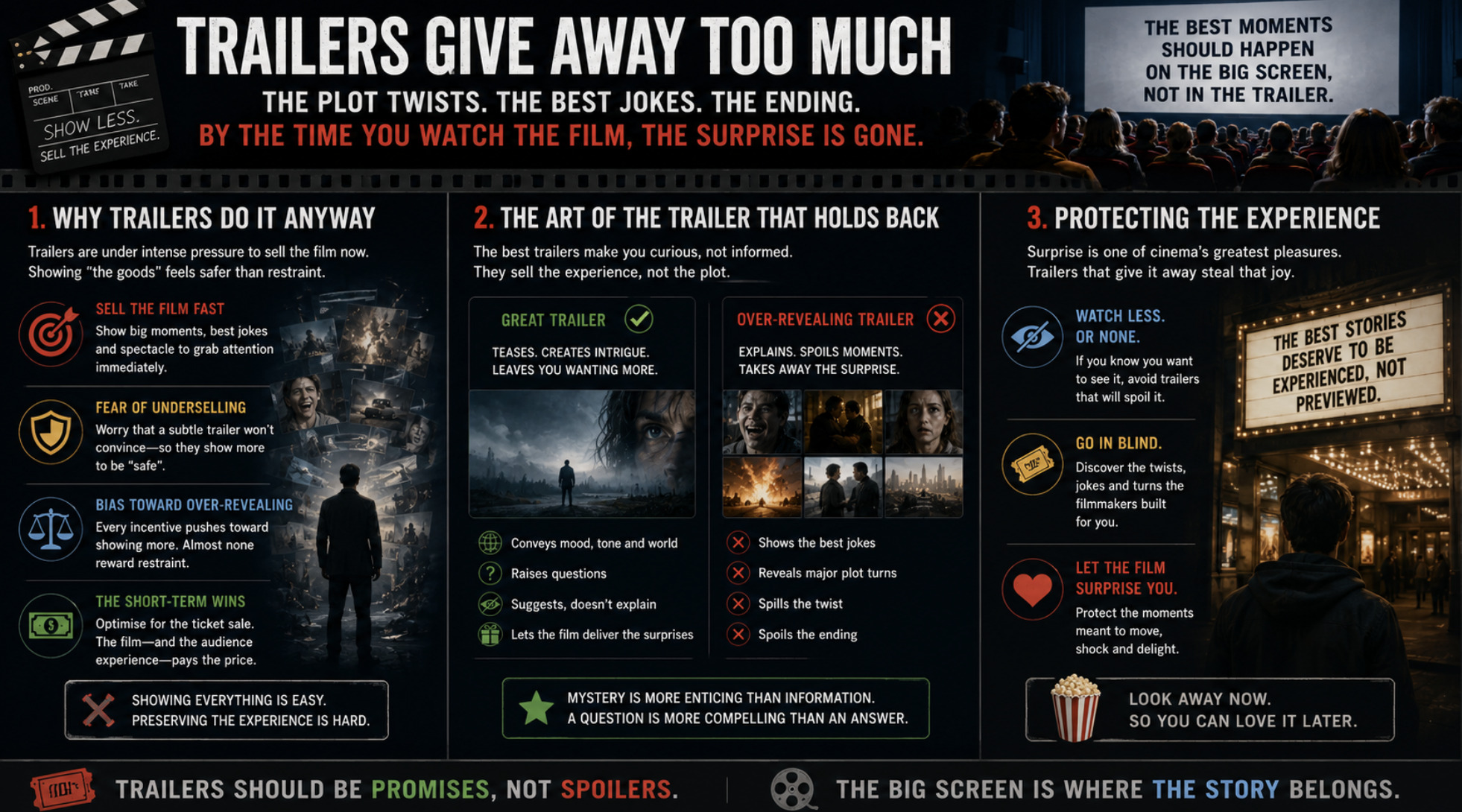
If over-revealing trailers hurt the films they advertise, why are they made this way? The answer lies in the pressures of film marketing, and it is worth understanding rather than simply condemning. A trailer is under enormous pressure to sell the film immediately and convincingly, to prove in a short span that the movie is worth the audience's money, and the easiest way to do that is to show the goods: the best jokes, the biggest moments, the most spectacular scenes. Restraint is a harder sell to nervous marketers than abundance, because a trailer that shows a lot feels like it is offering more, even though what it is really doing is offering the film's best moments away for free.
There is also a fear of underselling. Marketers worry that a subtle, restrained trailer will fail to convey enough to convince a hesitant audience, so they err toward showing more to be safe — cramming in the highlights to guarantee the film looks appealing. The result is a systematic bias toward over-revealing: every incentive in the marketing process pushes toward showing more, and almost none pushes toward the restraint that would actually serve the film. This is how a practice that damages the product becomes standard anyway — not because anyone wants to spoil films, but because the short-term logic of selling a ticket overrides the longer-term value of preserving the experience. The trailer optimises for the sale, and the film pays the price.
The art of the trailer that holds back
It is worth remembering that the over-revealing trailer is a choice, not a necessity, because the best trailers prove that restraint works. A truly great trailer can make a film irresistible while giving almost nothing away — conveying mood, tone, style and intrigue so powerfully that you have to see the film, precisely because you cannot tell exactly what will happen. These trailers understand that mystery is more enticing than information, that a question is more compelling than an answer, and that the goal is to leave the audience wanting rather than sated. They sell the film by promising an experience, not by summarising it.
This restraint is genuinely an art, and it demands more skill than the over-stuffed approach. It is easier to cut together a film's biggest moments than to distil its essence into something intriguing without being explicit; showing everything is the lazy option, and teasing brilliantly is the hard one. But the films whose trailers hold back tend to reward their audiences with the full force of their surprises intact, and the pleasure of watching a film whose turns you genuinely did not see coming is exactly what the over-revealing trailer destroys. Learning to watch films attentively includes noticing how they were sold to you, a habit close to the one we encouraged in how to watch a film like a critic — and once you notice how much trailers give away, you cannot unsee it.
Protecting the experience
The real cost of the over-revealing trailer is the erosion of one of cinema's central pleasures: the experience of discovery. So much of the joy of watching a film comes from not knowing — from being surprised by a twist, caught off guard by a joke, moved by a development you did not anticipate. A film is, in large part, a controlled unfolding of the unexpected, and the trailer that gives away its surprises steals that unfolding before it begins. It sells you a ticket to a film you have, in the ways that matter most, already partly seen.
For the viewer, the practical response is a small act of self-defence that more and more people are adopting: watching fewer trailers, or none, for films you already intend to see. If you know you want to watch a film, there is little to gain and much to lose from a trailer that will only spoil its best moments, and going in knowing as little as possible preserves the discovery the film was designed to deliver. It is a quiet way of protecting your own experience from a marketing practice that does not have your enjoyment as its priority. The film-makers built their surprises to land on you fresh; the trailer, too often, gets to them first — and the best thing you can do for a film you love the sound of is, sometimes, simply to look away until the lights go down.