How Cinema Turned Casinos, Gambling and Risk Into Visual Language
A casino is, on paper, a terrible film set. The light is flat and unchanging. Nothing outside marks the passage of time. The action, reduced to its essentials, ...

A casino is, on paper, a terrible film set. The light is flat and unchanging. Nothing outside marks the passage of time. The action, reduced to its essentials, is a person placing an object on a table and waiting. And yet gambling has produced some of the most visually distinctive filmmaking of the last sixty years. Casino culture in cinema isn't really about the mechanics of card games or the odds of roulette — it's about what filmmakers can do with waiting, with exposure, with the moment before an outcome is known. Few other settings hand a director so much dramatic material for so little narrative effort.
That's the real subject of this piece: not gambling as a subculture, but gambling as a device — a toolkit directors reach for when they need to visualize tension, class anxiety, obsession, or the fragile architecture of self-control. Across very different films, the table becomes a stage for psychology.
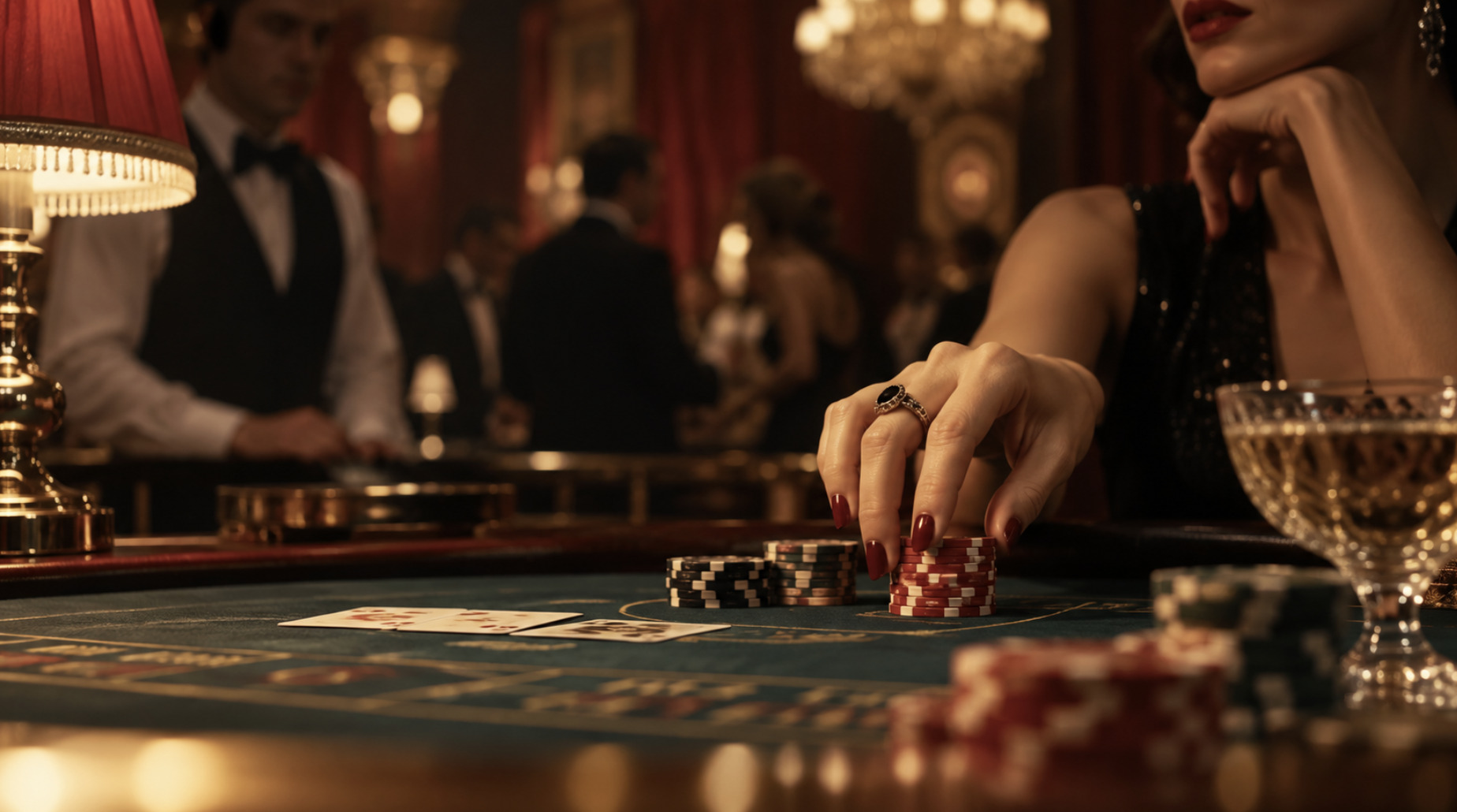
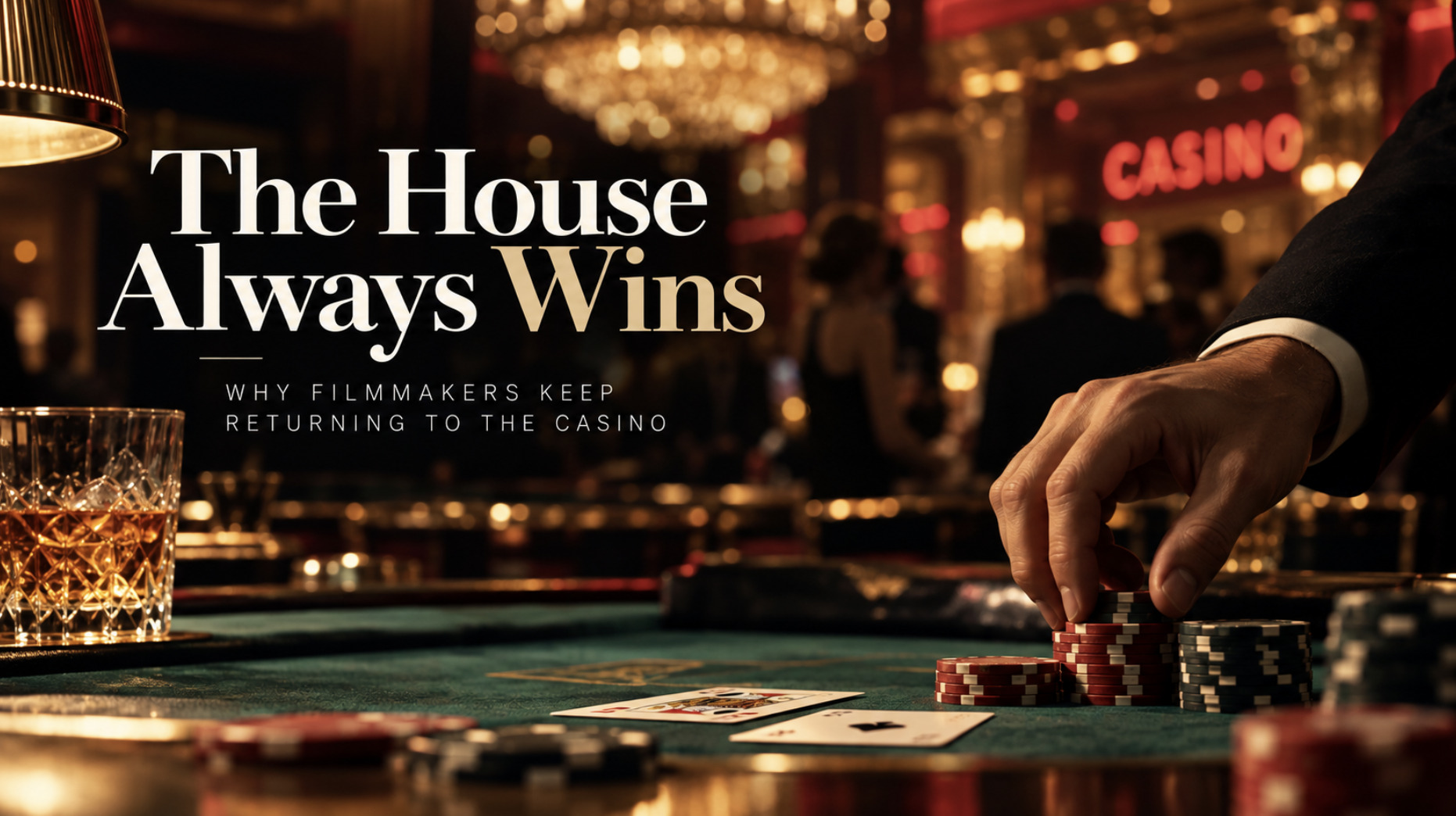
The House Always Wins — Why Filmmakers Keep Returning to the Casino
Every scene needs stakes, and gambling manufactures them instantly and visibly. Money changes hands in real time, in front of witnesses, under lights designed to make everyone look watched. That's rare. Most high-stakes decisions in life happen privately — a resignation letter, a diagnosis, a betrayal — and a film has to work hard to make them legible on screen. A bet does the work for free: chips move, a card turns, a face reacts, and the audience understands exactly what's at risk without a line of dialogue.
This is why gambling in movies recurs across genres that otherwise share very little — the heist film, the character study, the addiction drama, the crime epic. It isn't a genre in itself. It's closer to a grammatical unit, a scene-type directors deploy the way they might deploy a chase or a courtroom cross-examination, because it compresses uncertainty into something visual and finite.
What varies enormously, though, is tone. The casino can be shot as a cathedral or a trap, and the choice tells you everything about what the filmmaker actually wants to say.
Reading the Table — Cards, Chips and the Choreography of Tension
Norman Jewison's The Cincinnati Kid (1965) is often cited as the template for the modern poker film, and it's worth returning to for how little it relies on spectacle. The film's climactic hand between Steve McQueen's Kid and Edward G. Robinson's Lancey Howard is shot almost entirely in close-up: hands, eyes, the faint tremor of a cigarette. There's no crowd noise, no dramatic score swell — just the accumulation of small physical tells, cut with a rhythm that mimics the slow tightening of a decision. The tension isn't in the cards. It's in the editing, which keeps returning to faces at the exact moment the audience wants to see the hand.
Decades later, Rounders (1998) borrowed that same grammar but gave it a different social frame. Matt Damon's Mike McDermott narrates his relationship to poker in almost academic terms — pot odds, tells, the mathematics of risk — while the film's visual style stays grounded and unglamorous: dim backrooms, fluorescent-lit diners, a New York that looks lived-in rather than lit for effect. The Rounders film treats gambling less as spectacle and more as a discipline, a kind of blue-collar competence that happens to take place around a card table. Where The Cincinnati Kid is about nerve, Rounders is about literacy — reading a table the way another film might show a character reading a room.
Both films share a conviction that gambling scenes in film work best when the camera trusts stillness. The tension comes from restraint, not movement.
Scorsese's Casino and the Architecture of Excess
Martin Scorsese's Casino (1995) takes the opposite approach, and it's instructive precisely because of the contrast. Where Rounders strips the casino down to felt and cigarette smoke, Casino Scorsese-style is built from excess: sweeping Steadicam shots that glide through the Tangiers' gaming floor, saturated gold and red lighting, a camera that seems to worship the machinery of the place as much as the money moving through it.
That visual excess isn't decorative — it's argumentative. Scorsese uses the casino's glamour to implicate the audience in its seduction before slowly revealing the surveillance and violence underneath. The film's famous opening sequence, tracing the flow of money from the gaming tables to the counting room to the skimming operation above it, treats the casino as an assembly line disguised as a playground. The lighting is warm precisely so its coldness can land later. It's one of the clearest examples in casino movies of aesthetics doing narrative work: the audience is made to feel the appeal before being shown the cost.
Crucially, Casino isn't really about the games at all. Cards and dice barely register as gameplay; they're set dressing for a story about control, paranoia, and the specific American mythology of Las Vegas as a place built on the illusion of chance.
The Ensemble Heist — Ocean's Eleven and the Seduction of Risk
If Casino uses casino aesthetics to expose corruption, Ocean's Eleven (2001) uses nearly identical raw material — chandeliers, card tables, a Vegas skyline — to do the opposite. Steven Soderbergh's film is glossy, symmetrical, confident in its editing rhythms; risk here isn't dread, it's charisma. The heist crew's competence is framed as effortless style, and the casino itself becomes less a site of danger than a playground for cleverness.
This is worth dwelling on because it demonstrates how flexible the visual language of gambling really is. The same physical space — velvet ropes, roulette wheels, a vault — can be lit and cut to produce dread or to produce pleasure, depending entirely on what the story needs the audience to feel about risk. Ocean's Eleven treats a wager as an intellectual puzzle with a guaranteed solution; there's no real uncertainty, because the film has already told the audience its heroes are smarter than the house. It's gambling imagery stripped of gambling's actual psychological core — chance — and repurposed as a stage for competence.
Chaos at the Table — Uncut Gems and the Anxiety of Chance
Uncut Gems gambling sequences do almost the reverse. The Safdie Brothers' 2019 film is the clearest modern counterexample to Ocean's Eleven's cool control: it treats a bet not as a puzzle to be solved but as a compulsion the protagonist cannot stop feeding. Adam Sandler's Howard Ratner doesn't gamble to win so much as to keep the uncertainty alive, and the film's style mirrors that compulsion relentlessly — overlapping dialogue, a propulsive synth score, a camera that rarely holds still, phones ringing over each other in scenes that refuse to resolve cleanly.
The film's signature sequence — Howard watching a Celtics playoff game he's bet everything on, alone in a room, unable to look away — strips gambling down to something closer to a panic attack than a pastime. There's no elegance here, no choreography of hands and eyes like The Cincinnati Kid. Instead, Uncut Gems uses noise, duration, and visual clutter to put the audience inside anxiety rather than observing it. It's arguably the most physically uncomfortable gambling film ever made, and that discomfort is the entire point: risk in cinema doesn't have to be sexy or slow. It can be exhausting.
Class, Obsession and the Moral Weight of the Bet
Taken together, these films reveal gambling as one of cinema's most efficient shorthand devices for class and psychology. Casino's golden-lit excess is a story about who gets to profit from an illusion and who gets crushed underneath it. Rounders frames gambling as a meritocratic fantasy — skill over privilege — that the film is quietly skeptical of. Uncut Gems locates gambling inside a specific anxious, transactional New York milieu, where every relationship doubles as a hustle. Even Ocean's Eleven, for all its glamour, is a film about outsiders proving they belong in rooms built to exclude them.
What unites them isn't plot but function: gambling as a cinematic device for exposing what a character actually wants, and what they're willing to risk to get it. A poker hand or a roulette spin externalizes something usually invisible — a person's relationship to control, to luck, to their own self-image — and turns it into something the camera can watch happen in real time. That's a rarer gift to a filmmaker than it might first appear.
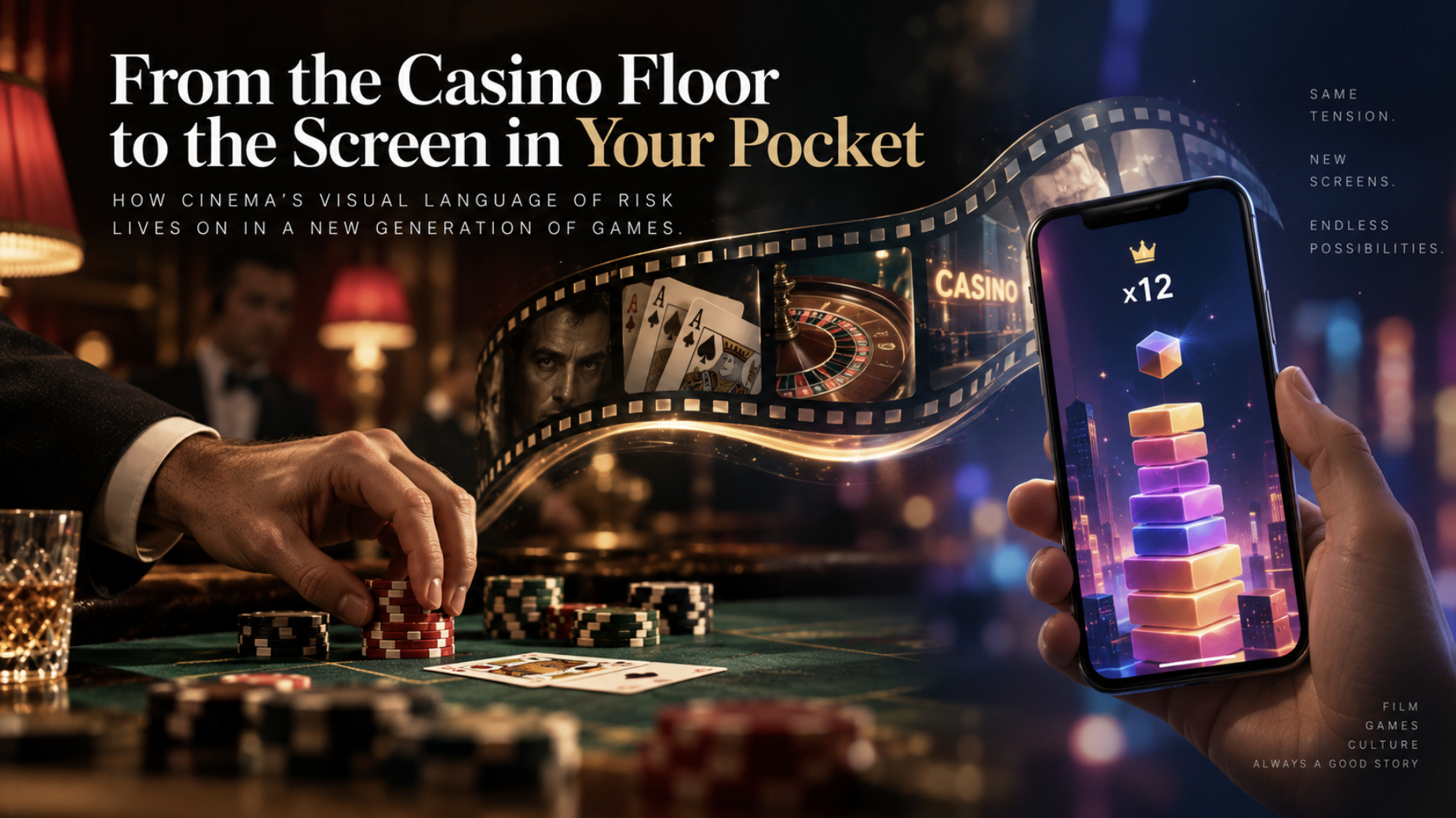
From the Casino Floor to the Screen in Your Pocket
What's less often discussed is how thoroughly this visual grammar has migrated beyond the films that built it. Cinema didn't just depict casinos — over several decades it effectively standardized a set of techniques for representing risk and anticipation: dramatic, directional lighting that isolates a single object of attention; a held beat of silence or near-silence before an outcome; a sound cue that signals arrival rather than accompanying it; a camera or composition that builds vertically toward a climax before releasing into a payoff. These aren't just casino conventions. They're storytelling conventions that happen to have been refined most intensely in casino scenes, because gambling gave filmmakers a perfect, compressed structure of anticipation and release to work with.
That structure has since been absorbed into interface and game design far beyond anything resembling a card table. The same rhythm — rising tension, a suspended pause, a resolving flourish — shows up in mobile and digital game genres that have nothing to do with cards or dice. Climbing or stacking formats such as Crazy tower games, for instance, are built around a vertical progression toward an uncertain point of failure or success, with a suspended moment before the outcome resolves — structurally the same anticipation-and-reveal beat that The Cincinnati Kid built out of a close-up on Lancey Howard's hands, just translated into an entirely different medium and genre. The visual language didn't stay in the casino. It became a general vocabulary for representing suspense itself, available to any format that needs its audience to hold their breath before a result appears.
This isn't a claim that such games are "about" gambling, or that they share gambling's mechanics — the point is narrower and more purely observational: the aesthetic toolkit cinema built for representing chance has outlived its original setting and now shows up wherever designers need to manufacture the feeling of a held breath before a reveal.
Why the Language Persists
It's worth asking why this particular visual grammar has proven so durable, across media that share almost nothing else. The likeliest answer is that anticipation is one of the few emotional states a director can manufacture almost mechanically — through pacing, silence, and a deferred cut — without needing exposition, backstory, or even dialogue. A bet is a promise that something will be revealed soon, and that promise is one of the oldest tools in visual storytelling, older than gambling itself.
What the casino gave cinema, in the end, wasn't a subject so much as a structure: a repeatable shape for turning uncertainty into something an audience can feel in their chest before they understand it with their mind. Scorsese used that structure to indict a city; the Safdies used it to simulate a breakdown; Soderbergh used it to celebrate cleverness. The table changes hands, the tone changes with it, but the underlying architecture — tension, suspension, release — has proven remarkably resistant to obsolescence, which is probably the clearest evidence that cinema didn't just borrow the language of chance. It built the language of chance that everything after has been speaking.