
Italy Picks L'Estranea for the 2027 Oscars as a New Rule Reshapes the International Feature Race
Italy's submission for Best International Feature Film at the 99th Academy Awards is L'Estranea, directed by Paolo Strippoli. Its English-language title is The ...

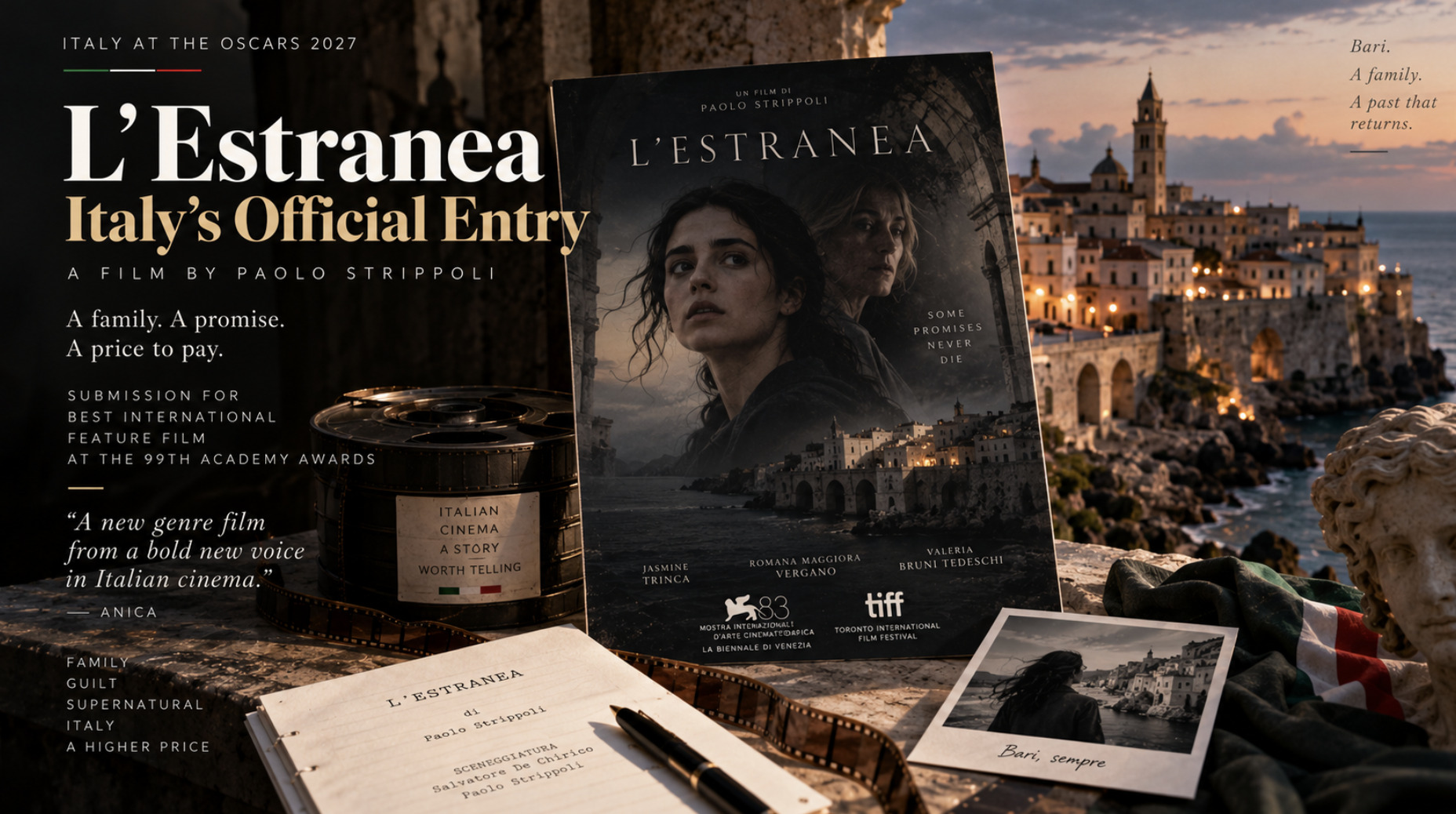
Italy's submission for Best International Feature Film at the 99th Academy Awards is L'Estranea, directed by Paolo Strippoli. Its English-language title is The Spiral. The selection committee convened by ANICA announced the choice on 23 September 2026. It picked the film from 21 eligible Italian titles, a list that included new work by Nanni Moretti, Gabriele Muccino, Riccardo Milani, Isabel Coixet and Andrea De Sica.
It is an unusual pick. Strippoli is 30-something director whose reputation rests on horror, and L'Estranea is a family tragedy with a supernatural bargain at its centre. The committee said as much in its brief statement, describing it as a new genre film by a young filmmaker at the start of his career, and noting that critics and audiences at home and abroad had responded to it.
The choice also lands in the first year of the biggest change to the category in its seventy-year history. For the first time, a country's official entry is no longer the only way into the race.
The Film Italy Chose
L'Estranea premiered in competition at the 83rd Venice Film Festival on 7 September. It played the Toronto International Film Festival four days later. 01 Distribution releases it in Italian cinemas on 8 October 2026. It is an Italian–French–Belgian co-production and runs 115 minutes.
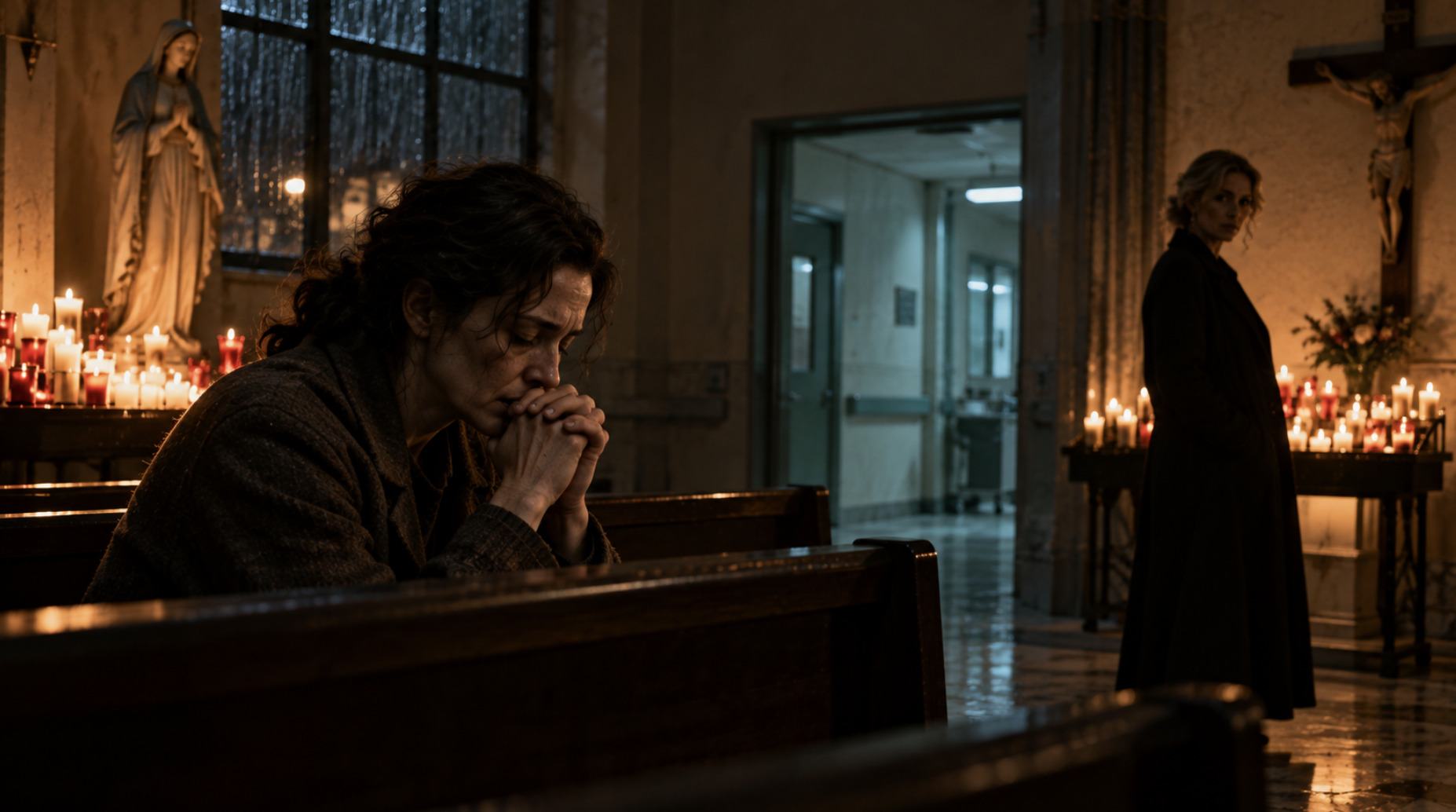
The story centres on the Colonna family, a wealthy Bari household whose public image depends on success and appearances. Twenty years earlier, when her young daughter Alice was badly hurt in an accident, Anna went to pray in the hospital chapel. There she met a woman who called herself only "the stranger." The stranger seemed to know everything about the family and offered a deal: Alice would be saved, but another life would have to be given up in return.
The film moves back and forth between that night and the present. Alice (Romana Maggiora Vergano) is now a fashion student in Rome. Anna (Jasmine Trinca) turns up at her apartment during a storm to confess what she did, and to warn that the consequences of the pact are catching up with all of them.
Valeria Bruni Tedeschi plays the stranger. Adriano Giannini plays the father, and Andrea Genovese plays the family's son. Strippoli co-wrote the screenplay with Salvatore De Chirico. Cristiano Di Nicola shot it, and Robin Coudert composed the score.
Most Italian reviews treated it as Strippoli's most mature work. Critics described it as a film that uses horror to tell a story about guilt, and about how far a parent will go to protect a child. English-language critics at Venice picked up on the same shift. Several reviews highlighted Bruni Tedeschi's playful, disturbing turn as the demonic stranger. One major trade review framed the film as confirmation of Strippoli's standing as Italy's leading new horror director.
Who Is Paolo Strippoli
Strippoli is from Puglia, and L'Estranea is shot partly in his home region. Over four features he has used genre in the way Italian cinema traditionally used melodrama: to talk about families, class and guilt.
A Classic Horror Story (2021), co-directed with Roberto De Feo, was a folk-horror film that commented on its own genre. Its global release on Netflix introduced his name to audiences outside Italy.
Piove (2022) turned grief within a family into something close to a curse.
La valle dei sorrisi (2025) brought him to Venice for the first time, outside the main competition.
L'Estranea (2026) took him into the Golden Lion competition a year later, as one of five Italian titles in the running.
That progression explains what the committee's choice signals. Italy has not sent the Academy a safe, established name. It has bet on a director whose films travel through the channels where genre cinema now finds audiences: streaming platforms, festival sidebars and critics who take horror seriously. That is analysis, not something the committee said. But the statement's stress on novelty and genre points the same way.
What Changed This Year
Since the award was created in 1956, each participating country has been allowed to submit one film, chosen by a national committee. That system kept producing situations that frustrated critics and filmmakers. The best-known example is Anatomy of a Fall. It won the Palme d'Or in 2023, but France did not submit it for International Feature. It still earned Best Picture, Director and Actress nominations and won Best Original Screenplay.
Dissident filmmakers faced a structural version of the same problem. Their home countries would never submit their work, so their films could only compete if a co-producing country, usually in Europe, chose to put them forward.
For the 99th Oscars, the Academy added a second route. A non-English-language film now also qualifies by winning the top prize at one of six festivals:
FestivalQualifying award2026 winnerSundanceWorld Cinema Grand Jury Prize (Dramatic)Shame and Money (Visar Morina)BerlinGolden BearYellow Letters (İlker Çatak)CannesPalme d'OrFjord (Cristian Mungiu)VeniceGolden LionWoman Unknown (May el-Toukhy)TorontoPlatform PrizeAngh (Theja Rio)BusanBest Film AwardTo be announced in October
Several details change how the category behaves.
The nominee is the film, not the country. A qualifying film is credited as the nominee in its own right. The director accepts the award on behalf of the creative team, and the director's name appears on the statuette plaque after the film's title. The Academy still does not treat the director personally as a nominee or winner.
A country can end up with more than one film in the race. If a festival winner is also picked by its national committee, it is listed as that country's official submission. If it isn't, it competes under its festival prize, and the country's committee remains free to choose another film.
Festival winners still have to be entered. Winning the prize makes a film eligible, but someone still has to submit it and campaign for it.

The First Festival-Route Contenders
The rule has already produced exactly the situations it was designed for.
Yellow Letters, İlker Çatak's Turkish-language Berlin winner, was submitted by neither Germany, which chose Sandra Wollner's Everytime, nor Turkey, which chose Like a Limbless Tree. Under the old system it would have been out of the race. It is now eligible.
Shame and Money, Visar Morina's Albanian-language Sundance winner, is in the same position: Kosovo submitted Blerta Basholli's Dua.
India now has two routes in. The official entry is the Marathi-language Gondhal. Angh, Theja Rio's debut feature shot on 16mm in the Konyak language and set in 1960s Nagaland, qualified by winning the Platform Prize in Toronto on 20 September.
Fjord shows the other side of the rule. Mungiu's film was already eligible through its Palme d'Or, but Romania made it the official entry anyway. Earlier there had been doubts over whether it had too much English dialogue. Its US distributor, Neon, said in July that the film meets the Academy's requirements.
Then there is Woman Unknown, which is directly relevant to Italy because it beat L'Estranea for the Golden Lion. May el-Toukhy's drama is set in Denmark in the summer of 1945. A young housekeeper's wartime relationship with a German soldier threatens her marriage to her wealthy employer. The Venice win makes it eligible whatever Denmark decides. Before Venice, the Danish committee had shortlisted it among three candidates for the country's official entry; the final Danish decision had not been published in the reports reviewed for this article. The film opens in Danish cinemas on 4 February 2027.
Where Italy Stands
Counting the honorary awards of the late 1940s and 1950s, Italy has won this category more often than any other country. Its recent record is thinner. The last win was Paolo Sorrentino's The Great Beauty at the 2014 ceremony, and the last nomination was Matteo Garrone's Io Capitano in 2024.
This year the Italian path looked narrow before the committee even met. Italian reporting noted that no Italian films were selected for competition in Berlin or Cannes, and that none of the five Italian titles in the Venice competition won a prize. L'Estranea goes into the race without festival awards to point to. What it has is a distinctive filmmaker, a cast recognisable to European audiences, and early international reviews.
The field it now faces is strong.
South Korea submitted Possible Love, Lee Chang-dong's first feature since Burning. It won the Silver Lion Grand Jury Prize at Venice, and Netflix releases it in November.
France chose Andrey Zvyagintsev's Minotaur, winner of the Cannes Grand Prix.
Poland chose Paweł Pawlikowski's Fatherland, which won Best Director at Cannes.
Japan chose Ryusuke Hamaguchi's All of a Sudden.
Spain chose La Bola Negra, from Javier Ambrossi and Javier Calvo, which won the People's Choice Award in Toronto.
Belgium chose Lukas Dhont's Coward.
Several of these already have US distributors: Neon, Mubi and Netflix appear repeatedly on the list. That matters more than it may seem. Reaching the shortlist depends on enough Academy members actually watching a film, and distributors with awards experience are good at arranging screenings, events and attention. Last season, Neon releases took four of the five nomination slots in this category. A newly announced national entry without that kind of support has to work much harder.
The expanded field adds to the difficulty. Festival-route films do not replace any national entries. They are added on top. The final list will therefore include more films with a festival prize as their calling card, all competing for the same limited viewing time among voters.
What Could Work in L'Estranea's Favour
It is too early for firm predictions, and anyone who claims to know how the shortlist will look in September is guessing. A few things are worth weighing, though.
Genre is less of a handicap than it used to be. This category has traditionally rewarded serious dramas about history, family and moral struggle. L'Estranea is one of those at heart, even though it reaches that territory through a supernatural bargain. A voter who distrusts horror may be surprised by how closely the film matches the category's usual concerns.
Performances travel. Jasmine Trinca and Valeria Bruni Tedeschi are both well known on the international festival circuit. Bruni Tedeschi's role is the kind of showy, unsettling performance that people talk about after screenings, which is how smaller films build word of mouth.
Timing works in its favour. With its Italian release on 8 October, there is time for international attention and for any US deal to materialise before voting for the shortlist begins.
What could hurt it is simple: the competition, the lack of a festival prize, and, as far as we could confirm, no announced US distributor yet.
Key Dates for the 2027 International Feature Race
30 September 2026: deadline for countries to submit their official entries.
8 October 2026: L'Estranea opens in Italian cinemas.
October 2026: Busan announces its Best Film award, the sixth and final festival route for this year.
15 December 2026: the Academy announces the International Feature shortlist of 15 films.
21 January 2027: nominations for the 99th Academy Awards.
14 March 2027: the ceremony in Los Angeles.
What to Watch For Next
The next test is whether L'Estranea secures US distribution and a campaign. That will tell us more about its realistic chances than any early ranking.
The second thing to watch is the first-year reception of the festival route itself. If Yellow Letters, Woman Unknown or Angh reaches the shortlist in December, the rule will have done exactly what the Academy said it wanted. It will also increase pressure on national committees to choose boldly, since their selection is no longer the only way their country's best film can reach the Oscars. Italy's choice of a young genre filmmaker over the more familiar names on its list may be an early example of that shift.
And if L'Estranea doesn't get through, its selection still marks a change. For decades, Italian genre cinema, from gothic horror to the thrillers of the 1970s, was admired abroad but not considered respectable at home. This year, the committee chose a horror-leaning film to represent the country's cinema at the Oscars.