Italian Neorealism. The Cinema That Learned to Look at Real Life
When Italy came out of the Second World War, its cinema found itself facing a country in ruins and an audience that no longer had any appetite for fairy tales. ...
When Italy came out of the Second World War, its cinema found itself facing a country in ruins and an audience that no longer had any appetite for fairy tales. Out of that fracture came Neorealism, the most important and most imitated movement in the history of Italian film — a way of working that, within just a few years, taught directors around the world to take the camera out of the studio and into real life. It was never a school with a written manifesto and a set of rules. It was a way of looking. And that way of looking would leave a mark deeper than almost anything else in twentieth-century cinema.
Breaking with the "white telephone" films
To understand how radical Neorealism was, it helps to remember what it broke away from. Italian cinema in the 1930s was largely escapist: elegant comedies set in bourgeois drawing rooms, a cinema the public mockingly nicknamed the "white telephone" films, after the furnishing detail that symbolized a prosperity that existed only on screen. It was reassuring, polished, and utterly remote from the poverty and tension of the real country.
The first genuine crack appeared as early as 1943, with Luchino Visconti's Ossessione, a dark, sensual film that many regard as the movement's forerunner. But it was only with the end of the war that the break became complete, almost inevitable. Faced with a nation that had to be physically rebuilt, telling stories about drawing rooms would have been an act of blindness.
Rome, Open City and the discovery of the street
The film that symbolically marks the birth of Neorealism is Roma città aperta — Rome, Open City — shot by Roberto Rossellini in 1945, with the war barely over and almost no resources. Rossellini filmed the Roman resistance using scraps of leftover film stock, real locations and real faces, with an urgency that registers in every frame. The result lacked the smoothness of the studio, and it was precisely that roughness that made it feel true. Audiences saw something on screen that resembled their own experience, and Italian cinema discovered that the street could be its most powerful set.
Rossellini continued the conversation with Paisà (Paisan) in 1946, an episodic film that moved up the length of a liberated Italy from south to north, and with Germania anno zero (Germany, Year Zero) in 1948, completing a kind of trilogy on the war and its aftermath. His lesson was unmistakable: reality, filmed honestly, is worth more than any plot engineered at a desk.
De Sica and Zavattini: the poetry of small things
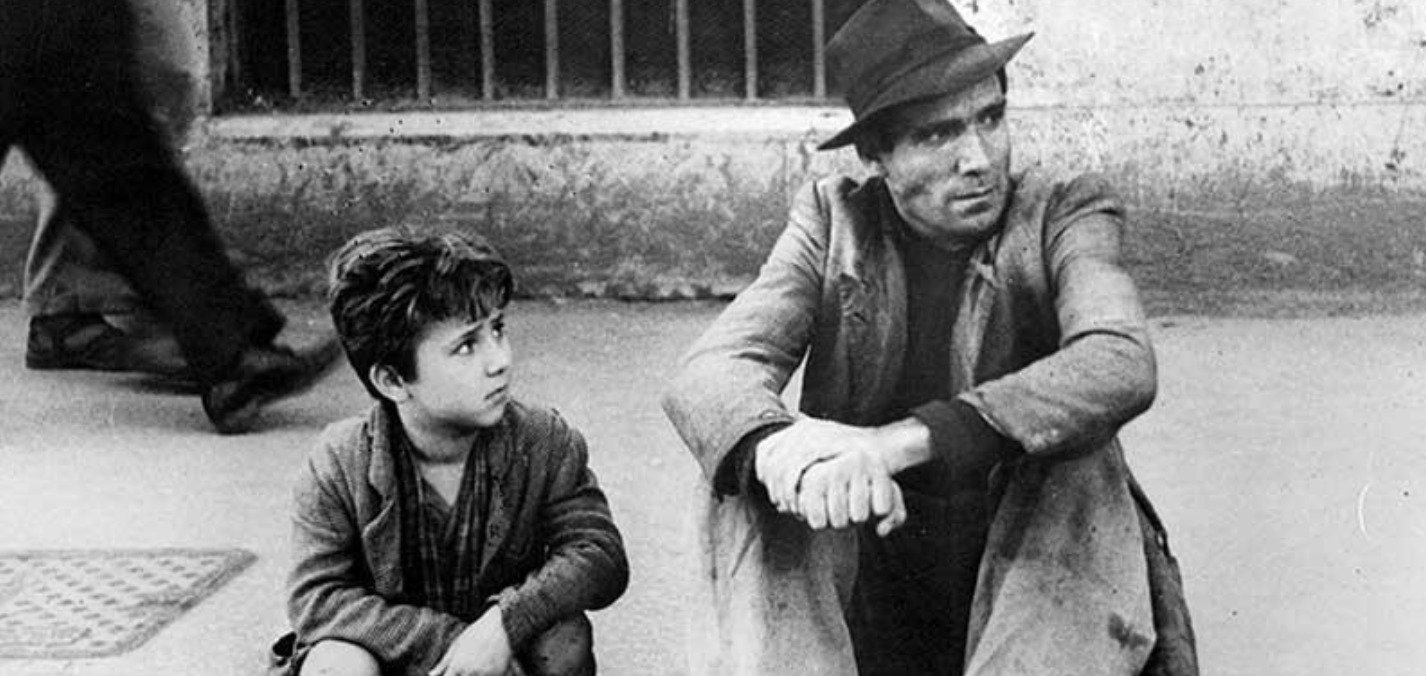
If Rossellini gave the movement its urgency, Vittorio De Sica gave it its tenderness. Working with the screenwriter and theorist Cesare Zavattini, De Sica made some of the best-loved titles of the entire period. Sciuscià (Shoeshine), in 1946, followed the street children of postwar Rome; Ladri di biciclette (Bicycle Thieves), in 1948, traced a man and his small son on a desperate search for the stolen bicycle his job depended on, and became the emblematic film of the whole movement, turning a tiny incident into a universal tragedy. With Umberto D., in 1952, De Sica pushed his attention to society's forgotten even further, portraying the loneliness of an elderly pensioner with a delicacy that still moves audiences today.
Zavattini's theory was radical. Cinema, he argued, should "shadow" reality — follow an ordinary person through an ordinary day, without inventing spectacular twists. It was an almost documentary idea, and yet out of that close attention came a particular kind of poetry, built from small gestures and glances rather than from incident.
Visconti and the gaze on labour
Luchino Visconti brought a different sensibility to Neorealism, at once more literary and more political. La terra trema (The Earth Trembles), in 1948, told the story of the fishermen of a Sicilian village using the real inhabitants of the place as performers and letting them speak in dialect, to the point of requiring subtitles for Italian audiences. It was an ambitious work, built like a fresco about labour and exploitation, and it showed just how broad the movement could be. Within the same brief season, the journalistic urgency of Rossellini, the tenderness of De Sica and the almost epic rigour of Visconti all coexisted.
An aesthetic born of necessity
What held together directors so different was not a uniform style but a set of recurring choices, many of them born from a lack of means before they were ever theorized. Films were shot in real exteriors, in actual streets and homes, because the studios had been damaged and money was scarce. Non-professional actors were often cast, chosen for their faces and their authenticity rather than their technique. Natural light was favoured, stories of ordinary people were preferred, and unemployment, hunger and the daily grind of getting by became the subject matter. Necessity became method, and method became a poetics.
The decline and an immense legacy
Like every great movement, Neorealism was short-lived. By the early 1950s the climate was already changing: reconstruction was underway, audiences began to want escapism again, and part of the critical and political establishment looked with irritation at a cinema that exposed the country's miseries. What followed was the so-called "rosy neorealism", which softened the tone toward sentimental comedy, while the major directors moved on to new and intensely personal paths.
Yet the movement's influence did not fade at all. Its lesson — go out into the street, film the real, give dignity to the overlooked — crossed borders and shaped the French New Wave, the British Free Cinema, the new cinemas of India and Latin America, and in truth the whole tradition of auteur film that came after. When a film today chooses the truth of a real place over the perfection of a set, it is still gathering up, perhaps without knowing it, the inheritance of those few extraordinary years of Italian cinema.
Frequently asked questions
What is the defining film of Italian Neorealism? Vittorio De Sica's Bicycle Thieves (Ladri di biciclette), released in 1948, is generally regarded as the emblematic film of the movement, for its ability to turn a small everyday incident into a tragedy of universal scale.
When did Neorealism begin and end? The movement took shape at the end of the Second World War, with Rome, Open City in 1945, and faded as a compact season by the early 1950s, even as it continued to influence later cinema.
Who were the main directors of Neorealism? The three essential figures are Roberto Rossellini, Vittorio De Sica and Luchino Visconti, alongside the screenwriter and theorist Cesare Zavattini, who was central to shaping the movement's poetics.
Why were non-professional actors used? Partly out of necessity, since resources were scarce, and partly as a poetic choice: the faces and bodies of ordinary people offered an authenticity that, in the directors' view, trained professionals could not always provide.