Steven Spielberg Returns to Large-Scale Science Fiction With Disclosure Day
There are directors whose names eventually become larger than genres themselves. Steven Spielberg belongs to that category. Audiences do not simply associate hi...

There are directors whose names eventually become larger than genres themselves. Steven Spielberg belongs to that category. Audiences do not simply associate him with science fiction, adventure, or blockbuster cinema — they associate him with the emotional architecture of modern popular filmmaking itself. That is precisely why every return he makes to large-scale sci-fi immediately becomes an industry event rather than just another studio release.
Universal’s newly released featurette for Disclosure Day offers the first substantial look behind the scenes of Spielberg’s upcoming science-fiction thriller, and it already feels positioned as one of the defining cinematic events of 2026. Scheduled for international release on June 12, the film arrives at a moment when Hollywood continues to struggle between franchise fatigue and audience demand for original spectacle. In that environment, a Spielberg-directed alien thriller written by David Koepp and scored by John Williams does not merely look nostalgic — it looks strategically rare.
The newly unveiled production featurette is careful not to reveal too much of the plot, but its tone makes one thing immediately clear: Disclosure Day is not being framed as another invasion movie. The film instead appears interested in the psychological, political, and emotional consequences of first contact becoming undeniable public reality.
According to the official premise, humanity formally learns that extraterrestrial life exists and that alien visitors have arrived on Earth. The revelation triggers a chain reaction of social, political, and deeply personal consequences whose scale quickly becomes unpredictable. Even within the short behind-the-scenes footage released by Universal, Spielberg repeatedly emphasizes not the spectacle of alien arrival itself, but the destabilization that follows collective certainty.
That distinction matters.
For decades, Hollywood science fiction has largely revolved around uncertainty. Alien stories traditionally operate through concealment, paranoia, secrecy, and disbelief. Close Encounters of the Third Kind, Signs, Arrival, and even The X-Files all depended on humanity struggling to confirm whether contact was real at all. Disclosure Day appears to skip directly past that phase. The world in Spielberg’s new film already knows the truth. The real conflict emerges afterward.
In many ways, this makes the project feel unusually contemporary.
Modern audiences live in an era where institutions collapse in real time under information overload, conspiracy ecosystems, and permanent digital panic. The central premise of Disclosure Day — the official confirmation of something civilization-changing — immediately raises questions far more psychologically complicated than simple invasion narratives. What happens to religion? Financial systems? Governments? Social trust? How does ordinary life continue once humanity understands it is no longer alone?
Spielberg has explored versions of these questions before, but the featurette suggests a darker and more mature perspective than some of his earlier extraterrestrial work. Where E.T. centered childhood wonder and Close Encounters approached contact with spiritual awe, Disclosure Day appears far more interested in collective destabilization.
Visually, the production footage presented by Universal reflects that tonal shift. The film’s aesthetic appears grounded, restrained, and unusually tactile for a contemporary studio sci-fi production. Rather than overwhelming audiences with digital excess, Spielberg seems to be leaning into practical environments, dense urban realism, and atmospheric tension. Several sequences shown in the featurette depict massive crowds staring skyward in silence rather than chaos, a choice that immediately evokes the director’s longstanding fascination with awe as cinematic language.
Even now, nearly fifty years after Close Encounters of the Third Kind, Spielberg remains perhaps the most sophisticated filmmaker in Hollywood when it comes to portraying collective wonder. Few directors understand how to stage human faces reacting to the impossible with comparable emotional precision.
That skill may ultimately become the defining strength of Disclosure Day.
The cast assembled for the project reflects the film’s prestige positioning. Emily Blunt appears to occupy the emotional center of the story, though Universal has not yet disclosed detailed character descriptions. Blunt’s recent career choices increasingly suggest an actress gravitating toward emotionally intelligent genre filmmaking rather than purely commercial spectacle. Her performances in A Quiet Place, Sicario, and Oppenheimer demonstrated her ability to anchor large-scale narratives without losing psychological realism.
Josh O’Connor’s involvement is equally interesting. Following the critical success of Challengers and La Chimera, O’Connor has rapidly become one of the most respected actors of his generation, particularly in projects balancing vulnerability with intellectual intensity. His casting hints that Disclosure Day may rely more heavily on character-driven drama than traditional action mechanics.
Colin Firth’s presence further reinforces that impression. Firth rarely appears in effects-heavy genre cinema unless the material carries strong thematic foundations beneath the spectacle. The supporting ensemble shown in the featurette also suggests Spielberg is building a story focused on institutions, families, and social collapse rather than isolated heroism.
Another major point of fascination surrounding the project is the reunion between Spielberg and screenwriter David Koepp. Their collaborative history includes Jurassic Park, War of the Worlds, and Indiana Jones and the Kingdom of the Crystal Skull. Koepp remains one of Hollywood’s most technically disciplined blockbuster writers, particularly skilled at balancing exposition-heavy concepts with momentum and accessibility.
Importantly, Koepp’s best work often treats spectacle as a consequence of human behavior rather than an end in itself. That sensibility appears deeply embedded into Disclosure Day. The featurette repeatedly frames alien contact not as an action scenario but as a destabilizing social phenomenon.
The return of John Williams may be even more emotionally significant.
At 94 years old, Williams remains one of the last living composers whose music alone can fundamentally alter the cultural scale of a film release. His partnership with Spielberg is arguably the most important director-composer collaboration in modern American cinema. The featurette includes brief glimpses of Williams conducting orchestral sessions, and even those fragments already suggest a score emphasizing melancholy and grandeur rather than militaristic intensity.
That musical direction aligns with Spielberg’s broader thematic evolution over the past two decades. Much of his recent work has become increasingly preoccupied with historical fragility, collective trauma, and moral uncertainty. Even when working within genre frameworks, Spielberg no longer approaches humanity with the uncomplicated optimism that defined portions of his earlier career.
That evolution makes Disclosure Day particularly intriguing because alien contact stories traditionally force filmmakers to reveal what they believe humanity fundamentally is. Optimistic directors see unity. Cynical directors see violence. Philosophical directors see transformation.
The featurette hints Spielberg may be aiming somewhere more emotionally ambiguous.
Several moments shown behind the scenes depict panic, mass surveillance imagery, political broadcasts, and widespread confusion, yet the tone never becomes fully dystopian. Spielberg appears less interested in apocalypse than in psychological recalibration. Humanity in Disclosure Day does not seem to collapse instantly. Instead, it appears to slowly lose its sense of certainty.
That distinction may ultimately separate the film from the majority of contemporary sci-fi thrillers, many of which mistake scale for depth. Spielberg has always understood that science fiction functions most powerfully when it reveals human emotional truth through impossible scenarios. The aliens themselves are rarely the real subject. The subject is how people react once their understanding of reality becomes unstable.
In that sense, Disclosure Day already feels connected to the lineage of Spielberg films that transformed genre cinema into emotional reflection rather than pure spectacle. The featurette deliberately emphasizes practical filmmaking processes, ensemble collaboration, and atmospheric realism in ways that almost feel oppositional to contemporary franchise filmmaking culture.
That positioning is unlikely accidental.
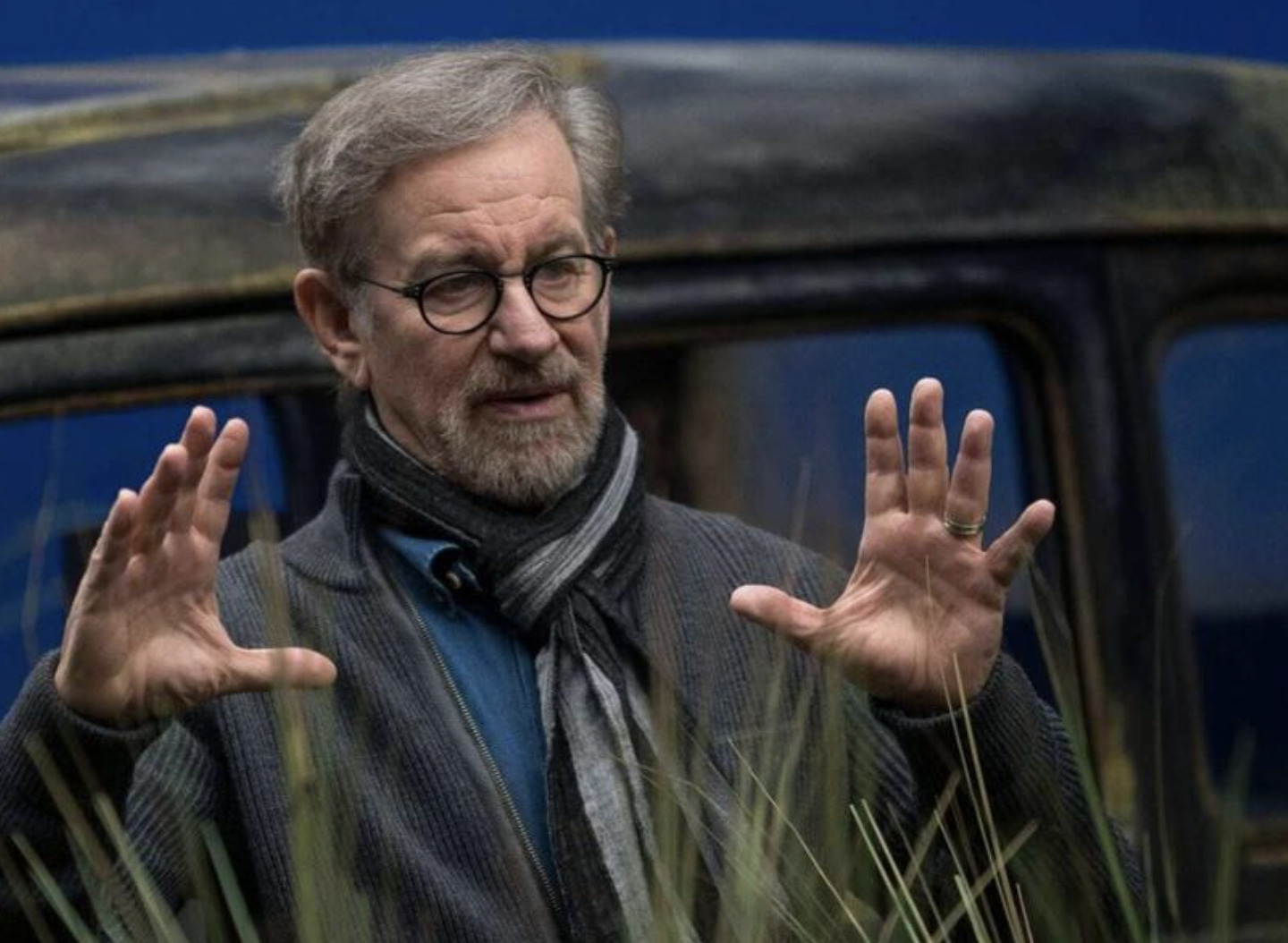
Universal clearly understands the marketing value of presenting Disclosure Day not as intellectual property, but as a cinematic event built around authorship. In a streaming era dominated by algorithmic sameness, Spielberg’s name itself becomes a form of differentiation. The featurette repeatedly foregrounds him directing actors, discussing emotional beats, and shaping scenes physically on set — a reminder that audiences are not simply buying tickets to a sci-fi thriller, but to a Spielberg film specifically.
That distinction still matters commercially.
Few filmmakers retain the ability to transform original material into global event cinema without relying on existing franchises. Even fewer can do so while maintaining serious artistic credibility. Spielberg remains one of the last directors capable of occupying both spaces simultaneously.
Whether Disclosure Day ultimately becomes another landmark entry in his filmography remains impossible to know this early. Featurettes are marketing tools by design, carefully constructed to manufacture anticipation. But even through that controlled presentation, the project already radiates an unusual degree of confidence.
Not confidence in visual effects or scale alone, but confidence in atmosphere, emotion, and thematic ambition.
And in contemporary blockbuster cinema, that may be the rarest thing of all.