Nosferatu 2025 è il film che Robert Eggers stava costruendo da sempre
Robert Eggers has been making the same film for a decade, in the best possible sense. The Witch, The Lighthouse, The Northman — each is formally distinct, each ...

Robert Eggers has been making the same film for a decade, in the best possible sense. The Witch, The Lighthouse, The Northman — each is formally distinct, each inhabits a different historical world, each approaches its material through different generic conventions. But the question running beneath all of them is the same one: what do people become when they are brought into contact with forces older and larger than the systems of meaning that organise their everyday lives? And specifically: what do women become?
Nosferatu is where that question reaches its fullest expression. Not because the earlier films did not ask it seriously — The Witch asked it with devastating precision — but because the source material demands it, and because Eggers has spent his entire career developing the formal language to answer it in the way it deserves.
The result is the most visually controlled horror film in decades, and the most psychologically serious vampire film since Werner Herzog's 1979 Nosferatu the Vampyre. It is not for everyone. It is for the people it is for in a way that almost nothing else has been.
The Visual Language: Shadow as Grammar
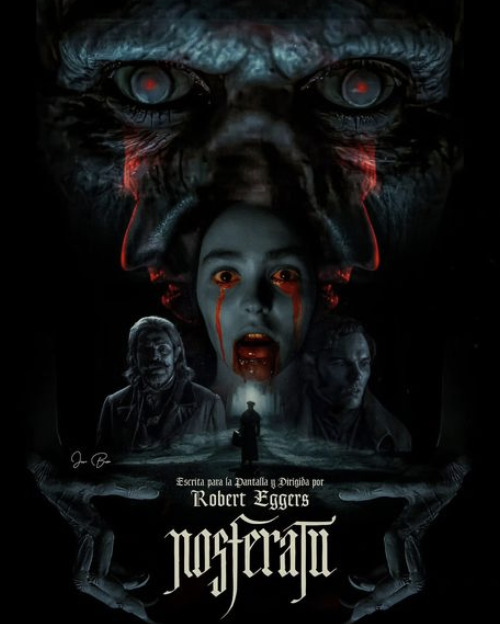
Eggers' cinematographer, Jarin Blaschke, who has shot all of Eggers' features, works here in a mode that draws from German Expressionism without reproducing it — the influence of Murnau's original is present, honoured, and transformed. The blacks in Nosferatu are not simply the absence of light. They are compositional elements as active as the figures that move through them, as intentional as dialogue, carrying meaning through their geometry and their borders.
The film is set in 1838, in a version of Central Europe that feels specifically historical — not generically medieval, not fairy-tale Transylvania, but a place with particular architecture, particular class structures, particular ways in which women's bodies are managed by the institutions designed to contain them. This specificity is not background texture. It is the condition of the film's central horror: that Ellen Hutter's possession by Count Orlok is not simply supernatural invasion but is continuous with the possessions the world around her has always practised on her, through different means and with different justifications.
Lily-Rose Depp: The Performance the Film Required
The reception of Nosferatu has been somewhat divided along the axis of Lily-Rose Depp's performance, and the division is instructive. Critics who expected a conventional horror-film lead — reactive, frightened, victim-shaped — found the performance mannered, overwrought. Critics who understood what Eggers was asking for found it one of the most precise physical performances in recent memory.
Depp plays Ellen as someone who has always been partially elsewhere — not mentally ill in any clinical sense, but constitutionally permeable to something the world around her cannot see. From the film's opening scene, before Orlok has appeared, Ellen's relationship to her own body and its desires is troubled in ways that the 1838 social context cannot accommodate. Her eventual possession is not the violation of a stable self. It is the arrival of something she was, in some sense, always awaiting.
This interpretation — which is faithful to the 1922 Murnau film, to Bram Stoker's source novel, and to the specific logic of the Gothic as a literary tradition — requires a performance that lives at the extreme edges of controlled affect. Depp delivers it. The scenes in which Ellen is in direct contact with Orlok's influence are physically extraordinary — gestures and expressions and bodily dispositions that communicate psychological states available to no conventional dramatic vocabulary. It is the kind of performance that looks like too much until you understand what it is too much of, at which point it becomes precise.
Bill Skarsgård: Presence Without Humanity
Count Orlok is the most formally radical of Eggers' character designs, and the most fully achieved. Skarsgård, who plays the role under extraordinary prosthetics and with a physicality that bears almost no relationship to his own body, creates a presence that is not human in any residual sense. Not a man with monstrous qualities. Not a romantic figure of darkness. A thing — ancient, hungry, patient, and specifically drawn to Ellen in ways that the film presents as predatory and as something more complicated than predatory simultaneously.
The complication is the film's most interesting moral space. Orlok does not merely want to feed. He wants Ellen in the way that the Gothic vampire has always wanted his victim — completely, possessively, with a claim that exceeds any social legitimacy but that the film does not allow to be simply dismissed. This is not an endorsement of obsession. It is a depiction of desire at its most destructive, rendered through the specific register of horror precisely because horror can show what other genres must euphemise.
The relationship between Ellen's interior life and Orlok's claim on her is where the film does its most difficult and most interesting work. It refuses the comfortable reading — Ellen as pure victim, Orlok as pure monster — without replacing it with an equally comfortable counter-reading. What it offers instead is complexity rendered with formal control: the acknowledgement that the Gothic's central dynamic is not simply about evil invading innocence, but about what innocence was asked to deny in order to remain innocent.
The Gothic Tradition and What Eggers Does With It
The Gothic as a literary and cinematic tradition has always been interested in what official culture suppresses — what bourgeois respectability requires its members not to want, not to feel, not to acknowledge. The vampire is the suppressed returning. The haunted house is the family secret made architectural. The woman at the center of the Gothic narrative is typically the figure through whom the suppressed attempts to surface, which is why she is simultaneously the most vulnerable character and the one with the most narrative significance.
Eggers understands this tradition precisely, and Nosferatu is his most thorough engagement with it. The 1838 setting is not arbitrary. It places Ellen in a specific historical moment of female suppression — before the first waves of organised feminism, before the medical establishment's relationship with female desire had been seriously challenged — in which the options available to a woman who experiences herself as Eggers' Ellen experiences herself are extraordinarily limited.
The horror the film offers is not primarily the horror of Orlok. It is the horror of a world that had already created the conditions for Orlok before Orlok arrived. The monster is, in the deepest sense, the product of the setting that produced Ellen. And the film's ending — which I will not describe, but which is entirely consistent with the Gothic tradition's most honest conclusions — does not resolve this horror. It confirms it.
The Film Eggers Was Always Building Toward
Every Eggers film has been, among other things, a formal study — a filmmaker teaching himself, in public, how to use period historical worlds as pressure systems for psychological and moral examination. The Witch was his education in folk horror. The Lighthouse in the psychology of isolation. The Northman in the epic form. Nosferatu is where the education becomes mastery.
The formal control here is total without being cold. The shadows mean things. The compositions argue. The performances are shaped with the precision of someone who knows exactly what each scene needs to do and has the collaborative vocabulary with his actors to get it. It is a film that rewards attention with the specific pleasure that only cinema at its most deliberate can provide: the sense that every element is necessary, that nothing is accidental, that the world on screen has been built with the same care and intention that the world it depicts could never offer its inhabitants.
It is also, finally and simply, frightening. Not in the way of jump-scares or shock gore. In the way of the uncanny, of the thing that should not exist but whose logic, once accepted, is airtight. That is the oldest kind of horror. It is the only kind that lasts.